Summer Reading 2020

Summer reading 2020

https://images-na.ssl-images-amazon.com/images/I/41Co3nyNoGL._SX347_BO1,204,203,200_.jpg

What Fresh Hell is This? by Marion Meade

I’ve been wanted to tackle this for a while – and Parker has been a fascination since I learned about the Algonquin Round Table. Meade brings DP alive in all her glory and got me interested enough in the period of publishing history to restart Thomas Kunkel’s Genius in Disguise: Harold Ross of the New Yorker.

The Confidence Game by Maria Konnikova

A readable exploration of why we fall for things – and why con artists do what they do and get away with it—the mark, the put up, the play, the rope, the tale, and more.

The Girl Who Lived Twice: A Lisbeth Salander novel, continuing Stieg Larsson's Millennium Series Kindle Edition

The Girl Who Lived Twice, The Girl Who Takes an Eye for an Eye, and The Girl in the Spider’s Web by David Lagercrantz

Propulsive page turners with workmanlike plots that don’t disappoint. But Lagercrantz is turning Lisbeth Salander into Jack Reacher. Or maybe she always was.

The Girl Who Takes an Eye for an Eye: A Lisbeth Salander novel, continuing Stieg Larsson’s Millennium Series (Millennium Series Book 5) Kindle Edition

The Girl in the Spider's Web: A Lisbeth Salander novel, continuing Stieg Larsson's Millennium Series Kindle Edition

https://images-na.ssl-images-amazon.com/images/I/51Ra+rhCGfL._SX322_BO1,204,203,200_.jpg

Zone One by Colson Whitehead

One of the things I love about Colson Whitehead is his range—everything from woo woo to and history–this was a real stretch. Engagingly weird and metaphorical—a plague generates a zombie apocalypse we follow a protagonist—a sweeper clearing the city of zombies– who consider himself overwhelmingly average.

The Nickel Boys (Colson Whitehead).png

The Nickel Boys by Colson Whitehead

A true history horror story of racism and brutality in the not-so-old south. The main character finds redemption and truth but with a twist.

Paperback The Best I Saw in Chess : Games, Stories and Instruction from an Alabama Prodigy Who Became U. S. Champion Book

The Best I Saw in Chess by Stuart Rachels

A multifaceted memoir by the youngest American every to become a chess master. Part instruction manual and part memoir in the narrative tradition of Korchnoi and Tal, but better written.

The Flanders Panel

The Flanders Panel by Arturo Pérez-Revert

Art restoration meets chess analysis. Tedious characters and disappointing in lots of ways but the chess problem was interesting if you like retrograde analysis.

How to Have Impossible Conversations: A Very Practical Guide

How to Have Impossible Conversations by Peter Boghossian and James Lindsay

A philosopher and a mathematician offer useful conversational techniques necessary for opening minds and navigating controversies. Useful material but the style if kind of self-helpy.

Understanding Beliefs

Understanding Beliefs by Nils Nilsson

I reviewed Roger Kreuz’s excellent book Irony and Sarcasm for Choice, which prompted me to reread Nils Nilsson’s Understanding Beliefs, which is a terrific and readable book on epistemology, the scientific method and problems of thinking by a computer scientist. I feel like working through the entire MIT Press Essential Knowledge Series.

Irony and Sarcasm

https://images-na.ssl-images-amazon.com/images/I/51roV3mOF8L._SX322_BO1,204,203,200_.jpg

Ready Player One by Ernest Cline

2044. A dystopian future with a nostalgia for the 1980s and combined with a fantasy quest. Better than the film version, which was also good, so it’s worth reading.

The Man in the High Castle

The Man in the High Castle by Phillip K. Dick

More dystopia, this time in an alternate reality 1962 in which the allies had lost world War II; lots of interesting features, but the story seems to flag at the end. It would be interest to teach this book though.

https://images-na.ssl-images-amazon.com/images/I/51SlEMYTYoL._SX331_BO1,204,203,200_.jpg

Making Sense of “Bad English” by Elizabeth Peterson

Clear and excellent textbook on language ideology and world Englishes and probably not too expensive to assign in a class.

Mutual Misunderstanding: Scepticism and the Theorizing of Language and Interpretation (Post-Contemporary Interventions)

Mutual Misunderstandings by Talbot Taylor

A deep dive into common sense and technical understanding of understanding. It turned me into more a of communication skeptic. Academic and historical, covering Locke, Saussure and more

The Wrong Case by James Crumley

1970s Montana noir. Crumley is a great writer but the story has an old school tough guy and doesn’t age well. Stick with James Lee Burke.

Audiobooks

A Most Wanted Man

A Most Wanted Man by John Le Carré

Le Carré’s thought provoking espionage thriller—packed with possible terrorists, bankers, lawyers, and agents–of works especially well as an audiobook, which has the right pace for all the intricacies. Now to watch the movie.

The Night Fire

The Night Fire Jonathan by Michael Connelly and The Wedding Guest by Jonathan Kellerman 

Two great police procedurals and listening to them was like begin with old friends. I prefer Harry Bosch to Alex Delaware as a character but the solve in The Wedding Guest was neater.

The Wedding Guest: An Alex Delaware Novel

1984: New Classic Edition

Nineteen Eighty-Four by George Orwell

I’ll be talking about this in class so it seemed like time to reread it; great performance by Simon Prebble and the audio brings out some new aspects of the book, including some flaws.

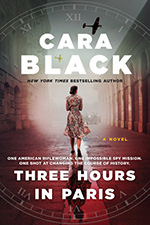
. Three Hours in Paris

Three Hours in Paris by Cara Black

This is the wonderful Cara Black’s 20th novel—and first stand alone?—featuring a female sharpshooter from Oregon who becomes an assassin in World War II. Her mission stalls and she must escape from France. Fast paced, intricate and sharply written

What Rose Forgot: A Novel

What Rose Forgot by Nevada Barr

An intergenerational thriller in which a women breaks out of a corrupt memory care facility and enlists her granddaughter in helping her on the run. Started out a little slow but ended up a fun romp.

Educated: A Memoir

Educated: A Memoir by Tara Westover

A colleague recommended this and I’m glad I read it. A harrowing tale of the effects of trauma, family dysfunction, gaslighting and conspiracy ideology—and the power of education. It gave me a new appreciation for some of the aspects of students’ lives.

Still working on Jonathan Lethem’s Men and Comics and Stephen Greenleaf’s Strawberry Sunday.

What was on your list?

Posted in Ideas and Opinions | Comments Off on Summer Reading 2020

An Interview with Tea Krulos, author of American Madness

Tea Krulos is a freelance journalist and author from Milwaukee, WI. He writes about art and entertainment, lifestyle, and food/drink for publications like Milwaukee Magazine, Shepherd Express, and Milwaukee Record. Other publications he’s contributed to include Fortean Times, The Guardian, Boston Phoenix, Scandinavian Traveler, Doctor Who Magazine, and Pop Mythology. You can find his a weekly column, “Tea’s Weird Week,” on teakrulos.com.

Tea Krulos - Wikipedia
Megan Berendt Photography

His books include Heroes in the Night: Inside the Real Life Superhero Movement ( 2013, Chicago Review Press), Monster Hunters: On the Trail With Ghost Hunters, Bigfooters, Ufologists, and Other Paranormal Investigators (2015, Chicago Review Press), and Apocalypse Any Day Now: Deep Underground with America’s Doomsday Preppers (2019, Chicago Review Press).

His most recent book is American Madness: The Story of the Phantom Patriot and How Conspiracy Theories Hijacked American Consciousness (2020, Feral House).

Ed Battistella: American Madness is a bio of sorts of Richard McCaslin. Who was he?

Tea Krulos: Back in 2010, I was working on my first book, Heroes in the Night, which is about a subculture of people who adopt their own “Real-Life Superhero” persona. Richard had seen that I was working on the book and contacted me, saying he was one of these Real-Life Superheroes and called himself the “Phantom Patriot” and that he had been arrested in 2002 when he started a fire in a secret retreat in northern California called the Bohemian Grove. It quickly became clear that he was a hardcore conspiracy theorist. I was interested in his life story and how he got there and began a long process of interviewing and researching.

EB: What’s your goal in the book?

TK: I think the first thing that really appealed to me was that Richard’s story hadn’t been told and I was in a unique position to be the one to tell it. As time went on, though, I found there was a bigger picture to this story. I found that Richard wasn’t alone in his views and that some of his beliefs and inspirations were becoming more prevalent. When I first started working on this book, people like Richard were really fringe and isolated. Now you have big social movements like QAnon that follow these ideas.

EB: I wanted to ask about your earlier book Heroes in the Night. Is there a connection between what you call the real life superhero movement and conspiracy theories.

TK: Real-life Superheroes (or RLSH) are a really eclectic group of people that share the desire to invent superhero personas and do good in the world. Most of them aren’t into conspiracy theory, but a couple of them are willing to entertain the ideas. Richard had a tough time breaking into the RLSH community, at first most of them didn’t want to be associated with him because of his beliefs. Eventually he did make a few RLSH friends and joined them on some meet-ups. But he really was, as he himself described it, “the black sheep of the RLSH.”

EB: Is there a particular type of person who is attracted to conspiracy theories?

TK: I think a lot of people have conspiracies they believe in, they’re just usually much more small scale– a conspiracy against you at your workplace, for example. I think people that get in deeper are really looking for meaning and order in this crazy world. There’s some appeal in thinking that a satanic network of Illuminati or “Deep State” is causing everything bad to happen. The Internet has really caused the widespread of some of these ideas. I quote a study in my book that found that almost 100% of flat earthers got sucked into the idea via YouTube. In Richard’s case, and other stories I examined I found that conspiracy believers had gone through a rough time in their life and conspiracy kind of filled the void they were feeling, almost like taking solace in a religious faith.

This image has an empty alt attribute; its file name is EfPUoSgWsAAW5a8.jpg

EB: You also talk about super conspiracies theories, where various conspiracies connect together, like Q-Anon.

TK: Yes, I think this is something that’s evolved. You used to find more theorists that had a conspiracy they focused on– “Assassinologists” are mostly interested in the JFK assassination. But most conspiracists now are super-conspiracists which means they’re likely to believe most conspiracy ideas they’re exposed to and believe that all of them are connected together, all perpetrated by this evil Deep State league.

EB: Is it possible to engage with someone who believes in conspiracies? What’s the best strategy?

TK: Sadly, it’s difficult to engage with someone after they make the conspiracy plunge. Almost anything you present to them– legit journalism or even photos or video will be dismissed as “fake news” or a “hoax.” It’s frustrating because how can you argue a point with someone like that? I think the best strategy is to not mock the person or get angry, but to listen and present why you think that they are wrong and point out the credibility issues with their sources. Hope for the best, but don’t expect them to budge in their thinking.

EB: Is the US more prone to conspiracy thinking that other countries or is this a world-wide phenomenon?

TK: It is world-wide. I just read a report about how QAnon has started to get a foothold in the UK, Germany, and other European countries. Other countries have long used conspiracy as a form of propaganda. That being said, conspiracy is very American. It’s gotten to be prevalent here, especially in this Trump era. From Bohemian Grove to Area 51 to Dealey Plaza, it’s part of our landscape.

EB: How do politicians respond to conspiracy theories? What should they be doing?

TK: Well, some conspiracy theorists are getting elected to office! Trump himself knows very well the power of using these theories as a weapon, whether it’s Birtherism, alleged voter fraud, or blaming his orange skin tone on energy efficient lightbulbs. The Trump effect has led to a number of QAnon inspired candidates to run– Marjorie Greene, a QAnon believer, is poised to win a seat in Congress this year and others look like they have a chance of winning, too.

That’s why I think it’s important to look at your local elections. It’s exhausting to keep up with all the misinformation, but I think media and politicians should be calling out Trump and other politicians spreading conspiracy every time. There is a war on reality about politics and the pandemic, and that should concern us all.

EB: Thanks for talking with us.

TK: Great talking with you, thank you!

Posted in Ideas and Opinions | Comments Off on An Interview with Tea Krulos, author of American Madness

An Interview with Stuart Rachels, author of The Best I Saw in Chess

Born in 1969, Stuart Rachels grew up in Birmingham, Alabama, and began playing chess when he was 8. At 11 he became a chess master and was the US Junior Champion in 1988 and the US co-champion in 1989. At the age of 23, he retired from competitive chess.

A former Marshall Scholar, he has a PhD in Philosophy from Syracuse University and teaches at the University of Alabama in Tuscaloosa. This year he published The Best I Saw in Chess (New in Chess, 2020).


Ed Battistella: When you were not quite 12,  you became the youngest chess master in US history. How did you learn to play and how did you get so good so fast?

Stuart Rachels: My brother David taught me the rules. I have no idea how I got good. It was just something my brain took to. It was also my most enjoyable period as a player. Getting good is more fun than being good.

EB: Reading The Best I Saw in Chess, it occurred to me that good chess books are equal parts narrative and analysis. Did you think about this balance as you were writing the book? Or think about the memoir genre more generally?

SR: Yes and yes. Here are some tips I gave myself. (i) In telling stories, just say what happened. Don’t give commentary. Commentary is boring, and anyway your readers will prefer their own interpretations, so don’t waste their time giving them yours. (ii) In writing your life story, don’t start with your birth and end with you sitting there writing your life story. Skip around in time. (iii) Autobiographical writing is about taming one’s ego. Write a lot of drafts; take a lot of time to gain perspective. (iv) Chessplayers don’t want to hear your life story. They want to see cool moves. Make it less about you. Every story you tell, you must earn with cool chess moves. (v) Don’t make yourself look good; let yourself look human. Aside from Bobby Fischer, Mikhail Tal was the best blitz player in the world during the 1960’s. Yet when Tal recounts a blitz tournament in his autobiography, the only position he gives is one in which he made a silly blunder. Does this make you think less of Tal? Not at all; just the opposite. (vi) Your main obligation is to your reader, not to yourself. Don’t suppress uncomfortable truths. They’re uncomfortable for you, not for your reader. And though you hate it, include games that you lost. Guess what? Some of the coolest moves you’ve ever seen were ones that kicked your butt.

EB: What was the toughest part of writing The Best I Saw in Chess?

SR: Finding the right title. Stuart Rachels’ Chess Career is too conceited. Also, the book is primarily about chess, not about me; it is a book of instruction, where the lessons come from my games. So the title should not cry out “autobiography.” Yet it shouldn’t ignore that element; How to Think about Chess Positions isn’t right, either. And the title should contain the word ‘chess.’ Also, it should say something about me, because, who am I?—I haven’t played chess in 25 years. (I covered that desideratum with a self-promoting subtitle.) It took me months to find a title I was happy with.

EB: This is one of the few chess books I’ve seen that has footnotes, which I think is great. What does your chess library look like?

SR: Disorganized. I’ve acquired so many chess books in the last few years that they’ve outgrown their bookshelf, and now that I’m writing another book (about fortresses), my books tend to wind up in stacks, relating to some theme. Footnotes are important. I use them for references and for jokes.

EB: Who are some of the best chess writers out there? Do they have anything in common?

SR: I was trying to combine the virtues of John Nunn and Mikhail Tal. Nunn explains chess ideas perfectly (accurately, succinctly, insightfully), but he displays no personality—no humor and nothing too personal. Meanwhile, Tal has never edited a sentence in his life (he dictated his books, and it shows), but his wit, affable nature and lack of pretension are manifested on every page.

EB: You mention that you don’t always calculate a lot of variations, but also that you sometimes run into time trouble. Can you say anything about your thought process during a game?

SR: My trainer once told me that I would get into time trouble even if I began the game with five hours on my clock. There’s always lots to think about, but my time mismanagement probably derived from my neuroses—a useful neurosis. I was always motivated by the fear that I was about to make a bad move. This anxiety helped me focus, but it also slowed me down. … As for my thought process, I’ll just mention the only thing which (I think) was unusual. Often, there would be the move I wanted to play (the move I was most comfortable with) and then this different move, which I didn’t want to play, but it might be best. At those moments, I would silently give myself a speech, arguing that the move I wanted to play was best—and then I’d see whether I found the speech convincing.

EB: You’ve played several former world champions—Kasparov, Anand, and Spassky. Who was the toughest?

SR: Kasparov is the greatest player ever, in my opinion. However, I can’t say who was toughest for me, because I played these players at different strengths, under different conditions. When I played Anand, we were both 14; when I played Spassky, I was 16 and was too nervous and starstruck to think clearly; and then I played Kasparov in two clock simuls. I will say that my most awesome experience was playing blitz with Anand. He thinks several times faster than most GMs. “Touched by God” is an apt phrase.

EB: You have a day job, as a professor of philosophy. Do you still find time to play chess?

SR: I play a little on the internet, but not much. It isn’t about time. I prefer in-person play, and the nearest grandmaster is 150 miles away—my friend Ben Finegold, who runs a great club in Atlanta.

EB: Thanks for talking. Good luck with The Best I Saw in Chess.

SR: Thank you!

Posted in Ideas and Opinions | Comments Off on An Interview with Stuart Rachels, author of The Best I Saw in Chess

An Interview with Neil Nakadate, author of Looking After Minidoka

Neil Nakadate is a graduate of Stanford and earned his M.A. and Ph.D. at Indiana University.  He is University Professor Emeritus from Iowa State University, where he received the Iowa State Foundation Award for Career Achievement in Teaching. He is a past president of the Board of Directors of Humanities Iowa.  His writing has appeared in various publications, including Aethlon, Cottonwood, ISLE, and Annals of Internal Medicine; he has co-authored two books on rhetoric and writing and has written a critical study of novelist Jane Smiley (2010).  His most recent book is Looking After Minidoka:  An American Memoir (Indiana University Press, 2013), which links his Portland family and Japanese American experience from immigration through the 20th century. 

Ed Battistella: Tell us a little about yourself and your career.

Neil Nakadate: I went to high school in Portland, then to Stanford. After that it was Indiana University for my M.A. and Ph.D. I taught American literature, courses on fiction, and various nonfiction writing courses, first at Texas and then at Iowa State.

EB: Your father was a doctor. I’m curious how you chose to become an English professor.

NN: My father wanted me to follow him into medicine, but in high school my affinity was for English and history—an inclination that was reinforced by some excellent teachers. In college I was pre-med until the second quarter of my sophomore year, when I gave up lab reports for writing papers on poetry and fiction. I eventually concluded that my family’s economic stability, established by two preceding generations, enabled me to make that choice.

EB: What prompted you to write Looking After Minidoka?

NN: I had been trying for years to write about my family, with a focus on the World War II years. But it became clear to me that my family embodied many of the key aspects of the larger Japanese American story—and that explaining “internment” would require discussing what preceded it and what came after. Meanwhile, I had become impatient with superficial historical accounts of the incarceration that reduced the experience to dates and statistics. I knew that the stories of individuals could provide texture and depth for the collective story. So I interviewed family members, engaged in research, read new material as it became available, and wrote and otherwise contributed in support of Redress. I organized my files. I wrote a few of the poems that would appear in the book. But I was preoccupied with teaching and writing about American literature—including multicultural American literature(s)—and rhetoric and writing. So my progress on Looking After Minidoka was fitful; more than half of it was written in the two years after I retired.

EB: What was the process of research like for a memoir spanning three generations?

NN: It was challenging but rewarding. For example, the family record included anecdotes, letters, memorabilia, interviews, ephemera, and photographs. The public record included census data and immigration records, maps, city directories, military history, and so on. I had to figure out how to sort through, organize, and present what was most valuable in all this without getting distracted and sidetracked. This was a challenge because I would periodically encounter a subtopic or detail that required me to modify my initial understanding.

EB: You were born in the Midwest and your family returned to Oregon after World War II. What are your recollections of growing up in Portland? Was the racism different than in the Midwest?

This image has an empty alt attribute; its file name is Mindoka_smallpostcard.-cover-copy.jpgNN: When I was a boy growing up in Northwest Indiana, it was ethnically diverse and the fathers typically worked in the refineries, steel mill, or shipyard. My father had gone there because that’s where he was offered an internship upon completing medical school in Portland. The diversity of East Chicago was largely Central and Eastern European in origin. Ours was one of the few Asian families, but (according to my parents) we were accepted as part of the general mix. My memory of elementary school in Hammond is of a brief race-related incident but no ongoing problems. This was in the decade after World War II. On the post-war West Coast the “unwelcome mat” had been put out for Japanese Americans returning from the camps, and that made returning to Oregon a challenge for many, even by 1956. My parents were able to buy a house in Southwest Portland, but only after having some offers wither under the objections of potential neighbors and vacillation on the part of realtors.

EB: In your book, you include a lot of your own poetry. What’s the role of poetry in a memoir like this one?

NN: The poems convey my personal connection to and feelings about elements of the larger story, and they help explain what inspired me to juxtapose my family’s story and the larger Japanese American story. Early on I knew I wanted to include the poetry, but I was also aware that publishers were resistant to mixed-genre books. Interestingly enough, by the time I finished writing, that resistance had diminished.

EB: What did you learn about yourself while writing the book?

NN: Who I am in relation to other Japanese Americans who are strangers, yet related.

EB: Today, as in the 1960’s, we are seeing a surge of civil rights protests and anti-racism. Do you see current controversies and struggles as coming out of 1960s activism or was something else at work. Or both? Are there lessons for today’s struggles against racism?

NN: What’s happening today seems in part a legacy of 1960’s protests and activism against war in Southeast Asia, for civil rights, in support of women’s rights. And both then and now what we see and say is amplified by mass media. During the 1968 Democratic Convention one salient chant heard on TV was, “The whole world is watching!” Today we have social media as part of the mix. At the core of Japanese American experience, 1960’s civil rights unrest and activism, and current issues and protests (regarding immigration, displacement and dispossession, citizenship, voting rights. . .) are some basic, ongoing questions: “Who gets to be an American?” and “Does everyone here have an opportunity to pursue the American Dream?” and “Who gets to decide, and on what grounds?”

EB: Thanks for talking with us.

NN: Thanks for asking.

Posted in Ideas and Opinions | Comments Off on An Interview with Neil Nakadate, author of Looking After Minidoka