
 Follow
 Heartwood by Amity Gaige
A thriller I’m for my book club. It involves an overlapping story and rotating narrative set on the Appalachian Trail. A middle-aged hiker named Valerie goes missing in Maine and Maine state game warden Lieutenant Bev Miller leads a search-and-rescue operation. It’s an adventure story, but also the tale of several family relationships—mostly mothers and daughters. It’s an uplifting and very literary tale at the end. I was happy to be introduced to Gaige’s work.
Death Doesn’t Forget by Ed Lin
I continued Lin’s Taipei Night Market series with this story featuring the murder of a criminal who wins the lottery. Soon after the police captain investigating the murder is killed as well and Jing-nan is questioned by the police. In this book, we get new backstory about Jing-nan’s friends Frankie the Cat, Dwayne, and his girlfriend’s Nancy and her estranged mother. It’s a convoluted plot, set against the background of the Austronesian Cultural Festival, but Lin’s engaging writing and insights about Taiwanese culture carry the day.
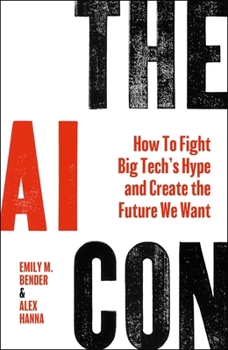 The AI Con: How to Fight Big Tech’s Hype and Create the Future We Want by Emily M. Bender and Alex Hanna
The AI Con is a sharp and breezily written critique of the overblown claims being made about generative artificial intelligence. The authors a linguist and a sociologist, give an expert take on the nature of the AI technology connecting it to statistical modelling techniques that have been around for a long time. They debunk the idea that AI is approaching human intelligence (and critique the notion of general intelligent itself) and they take us through some of the AI flubs and ridiculous claims (including some by AI sceptics). They followed the hype to the money and offer a welcome counterpoint to the all-too-common swooning over AI.
Bender and Hanna get into the details of the hype – what’s really being sold, how it’s being sold. They also get into why we as humans see the output of LLMs as a sort of people – because we use language for so much that we can’t help but seeing language as an indication of intelligence as we understand it day to day. It isn’t though. Again, LLMs don’t learn like an infant – they are just picking the next most likely word based on a statistical model.
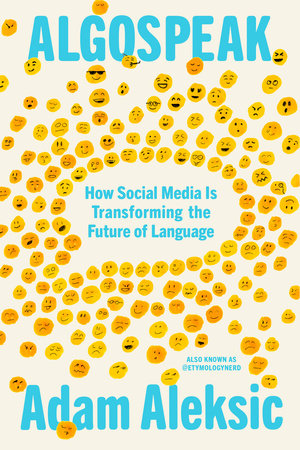 Algospeak: How Social Media Is Transforming the Future of Language by Adam Aleksic
I was pleasantly surprised by this book by an online content creators who goes by the handle “Etymology Nerd.” The title led me to assume that it would be yet another exposition of online vocabulary. There were plenty of interesting examples, but even more I found a thoughtful exposition of way in which social media algorithms and shadow banning shape lexical and linguistic trends by promoting certain lexical work arounds (such as the suppression of kill and suicide on TIKTOK, which has led to people unaliving others or themselves). Aleksic goes beyond lexicography to discuss the influencer accent – the way in which YouTube and TikTok shape voice with an influencer mode of speech to hold a attention. We also learn about the lexical tricks to get people’s attention in the first place and the roles of different online communities in online language innovation and the role of search engine optimization and segmentation in the attention economy.
Bobby Fischer: The Wandering King by Hans Bohm, Kees Jongkind
One of my chess friends gave this to me (thanks, Jim). Compiled by two Dutch journalists who were developing a Fischer documentary, it includes interview with chess luminaries who were in touch with Fischer after he abdicated the world championships and when he was deep in his paranoia, mental illness, and anti-semitism. It was first published when Fischer was still alive and the author struck a hopeful note that he would resurface. In all, a valuable addition to the Fischer saga.
I’m still working on The Politics of Language by Beaver and Stanley.
