
 Follow
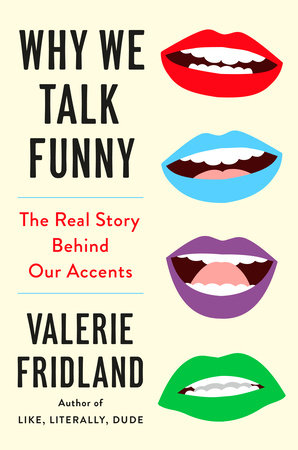
 Valerie Fridland is a professor of linguistics in the English Department at the University of Nevada, Reno and the author of Like Literally Dude: Arguing for the Good in Bad English and the 2026 release Why We Talk Funny: The Real Story Behind Our Accents. Her work explores how social changes, linguistic forces, and psychological tendencies reshape our language over time, impacting the way we think about and talk to one another.
Among other things, Fridland is a two-time National Endowment for the Humanities fellow and the recipient of the Linguistic Society of America’s Linguistics, Language, and the Public award, She writes a monthly blog on language-related topics for Psychology Today, is a regular guest writer for the popular Grammar Girl podcast, and has a lecture series, Language and Society, available with The Great Courses. She has appeared as a language expert in a variety of media outlets such as NPR, Armchair Expert, NBC, The Washington Post, the New York Post, the Wall Street Journal, and the New York Times.
EB: I really enjoyed Why We Talk Funny. Can you tell us why you wrote it?
VF: So happy to hear that! I wrote Why We Talk Funny because my parents were French speaking immigrants and, when I was a kid, I was hyper aware of the fact that there were not many other people who sounded like them in my hometown of Memphis, Tennessee. Everywhere we went, my parent’s accents were noticed and, as a result, we were treated a bit differently. As a child, feeling different is the last thing you want, but it really highlighted for me how important accents are to our identities and how others perceive us. This realization led, years later, to my interest in sociolinguistics, or the way that language and social life interact. Also, given the South’s own famed accent, there was a lot of awareness about accents more generally (or at least discussion about why Yankees sound funny), so I guess I had a lot of accent-oriented angst in my early life.
EB: Who is your book for? Who is the target audience? Who should I give a copy to?
VF: If you know anybody with an accent, this is the book for them – which means everyone since of course we all have accents.
I wrote this book specifically for non-linguists because there is so much rich history and science behind the reasons we sound the way we do and it is rarely unpacked for those who don’t work in speech science, cognitive psychology or linguistics. But it is so important to understand not only why we speak with accents but also how we hear with accents as well, because there is very little we do in life where the way we say things or hear things doesn’t matter.
EB: Part of the book gives the origin story of English in Britain and of language more broadly. But you also tell readers about your origin story as a linguist. How does one become a linguist?
VF: I think my early formative years as a child immersed in accents both foreign and Southern unconsciously primed me for a linguistic future, but I pretty much fell into linguistics as a field because I was a Chinese language major in college and had to take linguistics courses as part of that program. One of the early courses I took focused on the language of social life where we covered things like whether men and women differ in the way they talk and how age and ethnicity affect the linguistic choices we make and I was completely hooked. But to be a sociolinguist, you typically need an advanced degree, so I went on to get a PhD in linguistics. My first job after graduation was in Istanbul, Turkey as a visiting professor, where I was amazed at how people could tell that I was American from just hearing me say “Merhaba,” i.e., “Hello.” Accents at work again!
EB: One of your sections dealt with intrusive-r in warsh, which I have in my speech, off and on. What’s the story there with r?
VF: I love that you say “warsh” sometimes, as it is a receding feature, meaning that people don’t say it as much anymore as they used to. This pronunciation is a bit mysterious, since the ‘r’ is inserted into words where it doesn’t historically belong. It seems to be related to early colonial days when the “ah” vowel was pronounced with a bit more lip rounding than it is today, especially in the Mid-Atlantic colonies. Particularly before the “sh” sound, which involves the front of the tongue lifted toward the little ridge behind your teeth that you burn when you eat pizza, a rounder lip can cause the tail end of the vowel to sound a bit like an “r” sound. Thus, you get words like “wash” or “squash” that sounded more like “warsh” or “squarsh.” Since spelling was not tops on anybody’s list at a time when people were both likely to be illiterate and more concerned with surviving illness, conflicts, and starvation, the pronunciation stuck around – at least until greater familiarity with spelling became more influential on how people spoke.
In a slightly different version of an intrusive “r,” sometimes “r” gets inserted where it doesn’t historically belong in words like idea (e.g., “idear”) or law (“lawr”) because of the influence of a different process called “linking ‘r’.” This version applies mainly to cases where speakers don’t typically pronounce all their “r” sounds, as in some dialects of British English, and is a bit more complicated in terms of when and why it happens. The story of how we say (or don’t say) our “r” sound is one of the most fascinating tales in the book and it really illuminates how social triggers like migration, revolution, and changing ideology deeply impact the sounds we say.
EB: I have never thought about the aesthetics of accents and so I especially enjoyed the section on that topic. What makes a language or an accent beautiful or ugly?
 VF: I think we all have a language that we have a bit of a crush on – one that appeals to us even without understanding a word and one which makes speakers seem just a tad bit sexier. Rarely, though, do we spend much time wondering what makes for a love language, linguistically speaking. Luckily, researchers in an area called “phonoaesthetics,” or the study of the intrinsic beauty of sounds, have spent some time on this question. They have found a number of factors explain linguistic attraction. For one, languages with more open syllables, like “ta” or “la,” tend to be preferred, as well as those where sonorant sounds are more frequent, a category which includes all vowels and the sounds “l,” “r”, “m,” and “n.” One reason these features might be appealing is because they make a language sound more melodious and musical – in other words, they are more singable. The Romance languages, ones like French, Italian, Spanish and Portuguese, use more open syllables and sonorant sounds compared to Germanic languages like English, German, or Dutch, which might explain why Holy Roman Emperor Charles V claimed that he “spoke Spanish to God, Italian to women and German to his horse.”
EB: What’s your favorite odd fact about accents that you didn’t put in the book?
VF: One fact that didn’t make the book but I find fascinating is that there are some anthropologists and linguists, particularly those who are trying to trace the evolution of language in pre-history, who found that languages became less phonemically complex – or lost sounds – as they dispersed from the original source language in Africa some 50,000 or so years ago. For instance, some African languages, particularly click languages, have sound systems that number over 100, while most European languages, including English, have far fewer, around 30 to 40. This mirrors what has been found with genetic diversity, which also seems to have decreased with distance from Africa. However, this is still controversial as it is hard to really pinpoint anything about languages that no longer exist and for which we have no records.
EB: Thanks for talking with us.
VF: Sure. Thank you for the chance to chat a bit about Why We Talk Funny!
