
 Follow
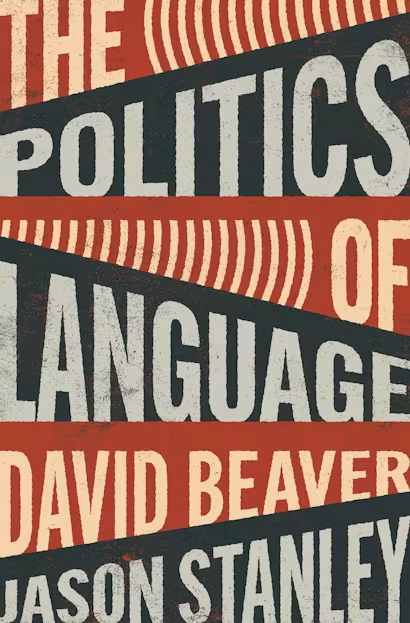 The Politics of Language by David Beaver and Jason Stanley
Published in 2025, The Politics of Language, by David Beaver and Jason Stanley convincingly makes the case that most speech has ideological meaning and that the connotations of words evoke emotions, images, and actions in listeners all of which can be manipulated by what they call “hustle” (communicative actions that are not transparent). The book offers a detailed critique of the so-called “content delivery model” of communication in favor a view of communication in terms of speech practices of communities. In a culture or subcultures, certain language practices presuppose the ideology and may further effect a harmony with social identity. They argue that linguistic neutrality is illusory and dispute the idea that there is such a thing as language that avoids ideology shading. If you are wedded to the idea that literal meaning, neutral language, and straight talk are the way to save civil society, this book will challenge those beliefs.
The work is a collaboration between David Beaver, a University of Texas scholar who has authored and coauthored books on semantic focus, logic and visual information, and dynamic semantics, and Jason Stanley, the University of Toronto scholar and author of How Fascism Works, How Propaganda Works and other books. This was a productive collaboration, resulting in a wide ranging 500-page book that draws on many fields beyond philosophy and linguistics. It is also a challenging book, best read in small bites, and Beaver and Stanley have done us the favor of organizing its eleven chapters into short sections of about five or so pages.
The key argument will be familiar to linguists, and Beaver and Stanley construct it in a unique fashion. Parts I and II of the book set out a novel theory of meaning. The first three chapters cover the concepts of resonance, attunement, and harmony. Beaver and Stanley discuss language in terms of the resonances (predictable actions) of words such as “freedom,” “vermin,” “inner city,” etc. but also note the resonances of phrases and images). Attunement refers to an individual’s predictable response to social practices, and harmony refer to the ways in which to the ways in which systems of attunement change (consonance or dissonance). They demonstrate how these features can come together into broader narratives which prime emotions such as hate and can generate contagions of hate.
Chapters 4 and 5 weave in the linguistics of presupposition, giving that concept a description in terms of resonances which can transmit and maintain ideology. As they explain it: “The power of political communication rests on its ability to draw attention, drive attunement, and differentiate adversaries.” They go into the concept fully, in all it linguistics glory, and extend it to show how accommodation makes presuppositions informative.
Chapter 6 “On Parole” gets to the concept of meaningfulness, defined this way
Something is inwardly (/outwardly) meaningful for some individual or group to the extent that it resonates for them (/for others) in a way that activates attunements that are distinctive to their identity. (p 269)
So for example, denigrating slurs or sexist comments will resonate with some listeners, spreading or reinforcing the discriminatory ideology such comments presuppose and layering them with other similar ideological presuppositions. They draw on the Communication Accommodation theory of Howard Giles and the idea of echo amplification to show how groups harmonize to the linguistic and symbolic practices of the ideologies of those whose opinions they value.
Part III of the book (IDEALIZATION) takes up notions of neutrality and straight talk as idealizations of democratic societies. In Chapter Seven they review the relevant literature, arguing that, at best, neutrality is a limited notion (and at worst an instrument of oppression). Chapter Eight similarly dissects the notion of straight talk as transparent language pointing out that many language practices (such as insinuation) involve hustle rather than transparency Together the two chapter challenge to notion of discourse that is free of perspectives, and thus free of ideology. Chapter Nine concludes with a critique of the idealization of ordinary language philosophy, arguing that the centrality of neutrality to academic philosophy and semantics has led to those disciplines ignoring the pervasive role of non-neutrality.
Part IV is titled OPPRESION AND FREEDOM, and here the authors show in some detail how different types of oppressive language work, beginning with slurs and genocidal language and moving on to bureaucratic language (with key examples from the Third Reich and from Michigan’s Emergency Management Law). The key idea continues to be the way in which the presumed neutrality masks the harm that is carried by such language. They end with an analysis of the arguments for free speech and some of the idealization that are involved in debates about its the scope and value. They suggest an equality-based foundation for free speech rather than a liberty-based one as a means of preserving a democratic discourse space in which necessary contests of meaning are possible.
While the book has serious philosophical chops (Wittgenstein, Austin, Grice, Stalnaker, Kartunnen, Kaplan, Heim, Saul, Camp, MacKinnon, Rawls, Tirrell and more), Beaver and Stanley have also woven in much research from psychology and sociology (Leon Festinger, Elizabeth Loftus, Daniel Kahneman and Amos Tversky, Dan Gilbert, Paul Ekman, Gregory Bateson, Stanley Fish, Victor Klemperer, George Lakoff and Mark Johnson, Judith Butler all have cameos) and from history and literature. Examples are taken from news and current events and ring true. Princeton University Press has done a fine job of producing The Politics of Language (footnotes rather than endnotes) and has included a helpful glossary of the technical terms. The Politics of Language is a book with several academic audiences in mind, and those less versed in the philosophical literature will need to reread certain parts to get the full effect. That’s a good thing, as this is a book that should be read and reread.
