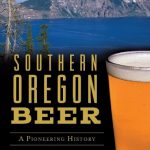

An Interview with Phil Busse, author of Southern Oregon Beer

Phil Busse is an Oregon writer and publisher. Raised in Wisconsin, he graduated from Middlebury College in Vermont, and began as career as a journalist with the San Francisco Weekly. He has written for the Eugene Weekly and helped start the Portland Mercury, where he was managing editor. Busse is the executive director for the Media Institute for Social Change and is the publisher and editor for the Rogue Valley Messenger, which provides news, entertainment and reviews to southern Oregon.

Southern Oregon Beer: A Pioneering History, his first book, was published in 2019 by the HISTORY Press as part of its American Palate Series.

Ed Battistella: How did you come to write a book on the history of Southern Oregon beer?

Phil Busse: I helped start the Rogue Valley Messenger six years ago—and have been the Publisher for the paper. Part of that job is writing beer reviews now and again. Last summer, I received an email from a publishing house asking me to write a book about the history of southern Oregon breweries. It was completely out of the blue.

I took a day to do some quick research to see whether there was even a story there—and quickly found some fascinating stories and characters, and wrote back to the publisher saying, “heck yeah!”

It was such a fun project to research – to learn about the dusty gold rush days of Jacksonville, to learn about how the railroads impacted local economies, to find out how big the hops industry was in the 1920s, not completely unlike the weed industry is today! It was just a great vantage point on history. I had so much fun researching this topic.

EB: The origins of brewing in the region seem to be in Jacksonville. Why there?

PB: Starting in 1851, Jacksonville was a gold rush town—a gold rush that coincided with a massive immigration of Germans; more than 1 million Germans arrived in America in the 1850s, with many finding boom towns like Jacksonville where they could make an impact and with a decent number of those Germans with beer brewing talents (Miller, Busch, Coors, Weinhart; these were all German immigrants arriving in America in those years). In the 1850s, southern Oregon was fairly desolate, but these settlers came with ideas about striking it rich—and a couple decided that starting up breweries for the their miners would be their ticket.

It was extremely isolated, though, so it is amazing that breweries started. Consider not only how tough it was to get the basics like wheat and hops, but to drag cooper tanks across the mountain passes!

EB: Some of the earliest breweries were run by women. Tell us about Fredericka Wetterer and Marie Kienlen, who you profile in the book.

PB: Yes, it is amazing that half of the breweries in southern Oregon in the 1880s/90s were owned and run by women. Beer brewing has been – and continues to be – a male-dominated profession, but in the late 19th century, it was a different story in southern Oregon.

Fredericka Wetterer was a German woman in Jacksonville. She came from a family of brewers, and outlived her husband who had started one of the first breweries in Jacksonville. She was interesting in the records she kept. Hundreds of receipts that helped tell the day-to-day story about running a brewery back then—about buying bales of hops from the Willamette Valley, about doing business with Henry Weinhart.

Marie Kienlen was a bit more zany. She was a French woman who landed in Grants Pass, and walked around town with parrots on her shoulders. With her husband, she bought a brewery – which, in turn, burned down. They rebuilt on the same spot, a brick building that today is Climate City Brewery. Unlike Fredericka though, there weren’t many records kept by or about Marie. Even basic information – like her birthdate – was impossible to pin down.

Even so, these two women give a lot of insights into what it was like to run a business in southern Oregon at the turn-of-the-century.

EB: There are some interesting historical and contemporary photos and lots of observations from the newspapers of the early years. What was the research like for you?

PB: Researching this book was both fun and like trying to solve a mystery. I was trying to piece together information to build a picture about what life was like. I found a number of great resources. Southern Oregon Historical Society was fantastic; just really wonderfully kind, helpful and interested in what I was doing. And, there were a couple databases of newspapers that gave me contemporary insights into people’s lives back then.

The book also talks about what is happening now, and has been happening for the past quarter-century. For that, I had a number of interviews with brewers, who all were excited to talk and share their thoughts—and beers.

EB: What was the impact of prohibition? How did brewers cope with that social change?

PB: Obviously, Prohibition had an impact. It shut down the breweries for 15 years (more in Grants Pass, which passed a resolution a full decade before the rest of the country). Interestingly, though, there were other market forces that were as big and damaging. I was surprised to learn that the peak of breweries in America was in the 1870s, with more than 4000 breweries, a number that wasn’t surpassed again until 2005!

The decline in that number started decades before Prohibition and was all about consolidation – and about local economies being undermined with national products like Budweiser came about and had distribution from a nationwide network of railroads. It isn’t a completely different story from what we’ve been seen in the past 20 years with the internet; a tension between locally-produced products and those easily available from national companies.

There was an upstart brewery in Medford, for example, but that was bought out by the Portland-based Weinhart, which was a big regional force.

It was a double whammie to local breweries – first, trying to compete with national brands and, second, becoming illegal from Prohibition. By 1933, when FDR lifted Prohibition, the number of breweries had sunk into the several hundred. It has taken decades for the diversity to recover.

EB: One of the results of prohibition was a ban on homebrewing, which lasted until the 1970s. How did Oregon become such a center of the homebrewing and then the craft beer movement?

PB: I’m not sure why Oregon became such a hub for homebrewing; really, all of the west coast. Maybe it is the pioneer spirit and spunk, or the notion of doing-it-youself. But yes, even after Prohibition was lifted, homebrewing was still illegal for five more decades. This was like removing the minor leagues from baseball; there was no training ground for small breweries to come up through.

Once legal again, though, there is a boom with small breweries. Something like 90% of that first generation of small breweries came from homebrewers; in southern Oregon, that was guys that started Walkabout and Caldera, and Wild River Pizzeria’s craft brewing.

EB: Any predictions for the future of Southern Oregon brewing?

PB: That’s a tough question. I like to think that the trend towards regional breweries will continue.

Southern Oregon Breweries really are gems—places like Portal and Opposition and Conner Fields that are so tied to their community. That is the spirit of the mid-19th century breweries that served as adult community centers in a way. I like to think that philosophy will only deepen. The economic trends seem to indicate that, although it can be a tough business, and is increasingly competitive.

EB: Where can readers get Southern Oregon Beer?

PB: The book is available at most book stores, and online at Amazon. I will have some readings and events in southern Oregon in late September and early October. I have a barnstorming tour, stops at Bloomsbury Books and also at various breweries and other events. We will announce those in the Messenger.

EB: Thanks for talking with us. Cheers.

PB: Cheers! I appreciate the interest in the book. I really am happy for the opportunity to share the history that I was able to piece together and write about.

Posted in Ideas and Opinions | Comments Off on An Interview with Phil Busse, author of Southern Oregon Beer

Eating With Our Eyes, a guest post by Jordan Hartman

Jordan Hartman is an aspiring writer and photographer based in the Rogue Valley. He has recently graduated from Southern Oregon University with a Bachelor’s degree in English. Jordan has been honing his culinary skills for over eighteen years.

Being able to taste an image means that a photographer has done their job perfectly. Food is not only meant to be eaten it is meant to be experienced. Photographs can only do culinary masterpieces so much to convey the plethora of senses that are experienced during the act of eating. Many professional publications come close to portraying the senses experienced while eating in their photography. But as amateur photographers and chefs we could never come close to the perfection that they portray. I decided to try my hand at preparing and photographing dishes in two cookbooks that are photocentric.

One of the books used for this study is Better Homes and Gardens an extremely well known culinary text, and many would not consider a home complete without this book. It is a culinary text that mainly focuses on homemaking and hosting for beginners. It is a wealth of culinary knowledge. The other cookbook I used for this project was The World in Bite Size by Paul Gayler and photography by Peter Cassidy, this book is not quite as prominent as Better Homes, but has a lot of value in regard to photography. The book focuses on the recent surge in popularity of tapas and other appetizers. When I was contemplating this study I scanned through the books and decided that the two recipes that contrast each other well were the “piggyback dates on polenta” from Bite Size and “Flat-Iron Steaks with Avocado butter” from Better Homes. The reason I chose these two recipes is because I felt that “piggyback dates” would challenge me more due to the polenta component, and the “Flat-Iron Steak” recipe because I have never worked with Flat-Iron steaks before, but it was a fairly basic recipe. Although these recipes seemed fairly basic the “piggyback dates” recipe gave me extreme difficulty in preparing it.

The photos for the recipe gave a false sense of simplicity:

“Piggyback Dates on Polenta” Peter Cassidy, The World in Bite Size

“Piggyback Dates IN Polenta” Jordan Hartman

To begin, the recipe called for instant polenta which I prepped twenty-four hours in advance by bringing to a boil and simmering. I then placed the polenta in a greased baking dish and let chill. Unfortunately I am not well versed in making polenta so it did not set correctly. I then placed it in the freezer for the day hoping that when I revisited it later I might be able to salvage it. I was wrong, the difficulties with this recipe had only begun. When I finally came back around to make this recipe I realized I did not have a grill pan so I tried to just use a regular frying pan coated with olive oil. This decision was costly, because when I added a polenta square to the pan it sizzled and shot a chunk of corn meal into my eye. The polenta square then began to turn to mush in the pan, and I quickly changed my attention to my barbeque. When I switched to the barbeque I first placed a polenta square on the grates and it slowly started to melt through. I decided to just throw the remaining polenta in a baking dish and make creamy baked polenta. I then placed the bacon wrapped dates on the grill, but forgot to keep an eye on them and returned to a grease fire with most of the dates charred to a crisp. Unfortunately the only salvageable date was the one photographed above. This recipe seemed so novice at first glance, but proved to be one of the most difficult, and frustrating, recipes I have ever undertaken. One of the main lessons for this recipe was to actually read the recipe all the way through before attempting. I also realize now looking at the photo post-production that the lighting on the image is too flat. I needed to deepen the light with a darker filter, and angle it from the back more. Taking into consideration all of the failed aspects of this recipe, the learning experience was more valuable than anything.

The other recipe, “Flat-Iron Steaks with Avocado Butter”, was much easier to execute than the “piggyback dates.” The recipe is a straight-forward grilling recipe with an avocado compound butter pictured below next to my attempt:

“Flat-Iron Steaks with Avocado Butter” Photographer Unknown, Better Homes and Gardens

“Flat-Iron Steak with Avo Butter and Home Fries” Jordan Hartman

Obviously the potatoes are different, I will get that out of the way now. I forgot to write the type of potato I thought the recipe called for before go to the store, and thought that the small yukon golds were the right potato. This is most certainly the case, but they were still delicious. The process for grilling the steak was fairly easy, and it looks as though I matched the coloration of the official photograph. The avocado butter ended up being slightly lumpy, and in the future needs a food processor to gain the smoothness of the official photograph. The execution of my photograph turned out better than I had hoped. I feel as though my photo is slightly cold compared to the original photo, but I feel as though my attempt does the recipe justice.

Although I had a moderate amount of difficulty between the two dishes I am very satisfied with the outcome. Most food photography is not meant to be eaten and that was a factor that had to be taken into consideration throughout the duration of this study. Many of the photographs used in the culinary world use inedible items to make them more appetizing to the eye, but would cause major harm if ingested. Although these photographs did not turn out exactly like the original images for various reasons the outcome was satisfactory.

Works Cited

Gayler, Paul. The World in Bite Size: Tapas, Mezze, and Other Tasty Morsels. Edited by Peter Cassidy, Kyle Books, 2008.

New Cook Book: Better Homes and Gardens. HougHton Mifflin Harcourt, 2014.

Works Referenced

Bright, Susan. Feast for the Eyes the Story of Food in Photography. Aperture, 2017.

Posted in Ideas and Opinions | Comments Off on Eating With Our Eyes, a guest post by Jordan Hartman

An Interview with Sophia S. W. Bogle, author of Book Restoration Unveiled

Sophia S.W. Bogle is an expert in book restoration with a diploma from the American Academy of Bookbinding and over 25 years of hands-on experience. She founded Save Your Books (formerly Red Branch Book Restoration) in 2000. 

Among her thousands of book restorations are first editions of Darwin’s Origin of Species, The Kelmscott Chaucer, and The Wonderful Wizard of Oz.  She is the author of Book Restoration Unveiled, which is just out and available in three formats: See below for more details.

Sophia will be at the Ashland Book Exchange celebrating and signing books from 4-6 on July 5.

Ed Battistella: Who is Book Restoration Unveiled for?  Who is your audience?

Sophia Bogle: The book evolved as I wrote. I started out writing it only for book collectors and then it expanded to include book dealers and then it expanded again because I realized that anyone who loves books should know these things. 

EB:  One of the things I found fascinating in the book and in your presentations is the history of book restoration and repair—can you tell our listeners a bit about the Florence Flood in the 1960s?

SB: The Florence Flood was a huge turning point. Before the flood, innovations in book repair technology just sort of followed behind whatever the art world was doing for art restoration. The flood damaged so many books all at once (millions) that it forced a shift. New techniques had to be invented quickly. Some worked, some didn’t, but the combination of moisture and heat made the books into time bombs for mold as well as pages getting stuck together. It was a real Mission Impossible moment and Peter Waters emerged as the hero. He led hundreds of “mud angels”(as the volunteers were called) through the muck of the detritus from the flood to rescue as many books as they could. 

EB: What’s the distinction between repair, restoration and conservation in a nutshell?

SB: First of all, Conservation is a profession. The people who do it are Conservators. What they do mostly is preservation but they also do restoration. The goal of preservation is to maintain the original object into the future with minimal change to the object. You can use the words conservation and preservation in the same ways but I find that confusing. 

Second, repair is both the overarching term for any treatment of something broken and it can also refer to simple treatments that are not fussed about matching or being invisible. 

Third, restoration is focused on invisible treatments that will bring the book back to functionality and its original beauty. 

EB: How does it feel to work with rare books—you’ve handled some first editions and even a Shakespeare First Folio in your career.  Do you have a sense of awe when you work with such rare pieces? 

SB: It is certainly wonderful to hold such a book and imagine the history. It means even more to me now that I have seen the play The Book of Will which was at OSF last year. The First Folio came through the shop when I was working for David Weinstein. It didn’t actually need any restoration at all. David just did a bit of treatment on the leather for preservation. In my interview with David in the book (BRU) he talks about the very interesting story of its sale.

EB: In Book Restoration Unveiled, you mention that some people think that book restoration and making facsimiles is inherently a bad thing. What do you say to that?  Can book restoration be used for good and evil?

SB: I am not sure that there is anything in the world that cannot be twisted with evil intent. I truly believe that the answer is always more information. I say that because I have had experience with some book people who have suggested that I should not be telling people about how some of these frauds are perpetuated. Their thinking is that now more people will commit crimes. I say that no information can create the intent. The intent exists aside from information. It is more important to arm the general public with the tools to spot it!

EB: You also talk about book restoration fraud? What is the most common type of fraud?

SB: There are three things that come to mind. Swapping out pages with publishers information in order to make the book appear to be a more valuable edition. Scratching out/removing numbers or words for the same purpose. And lastly, swapping out pages to insert the author’s signature.  None of those things can be done without intent to defraud and it is the intent that matters most. 

EB: One of the great features of your book are the many interviews with book professionals.  What was your idea in doing that? What did you learn from talking with them? 

SB: The interviews came out of a need to understand how others in the book world saw restoration. I was aware of a certain paradox that I wanted to clarify. You see, book restoration is both revered and shunned or hidden. Book dealers will only reluctantly tell you about who does restoration for them because they don’t want their book restoration person to get backed up and not have the time to do that dealers’ books. 

Also, dealers and collectors know that a book that has been restored is then not seen as a perfect book and so a stigma is attached. The stigma is attached even though the book was broken in the first place. This is due to the top 1% of book collectors preferring untouched books and so is market driven. 

The last part of it is that some people have been using the skills of book restoration to have shady things done and they don’t want to be caught. I have turned away some people when they asked me to do sketchy things. In the book I mention how one person asked me to change the name of the publisher on the spine of a book. I could have done it but I could not see how that wasn’t fraud so I declined.

EB: There is an Antiquarian Booksellers’ Association of America code of ethics.  What does that entail?

SB: The important thing is that they must declare any changes made to a book meaning restoration or re-binding mostly. Also they must accept returns if the book is not as stated. 

EB: Can you tell us a little about the Print-to-Sew version (sew-your-own-version delete) of Book Restoration Unveiled and about your video courses and book repair kits.

SB: I have created a Print to Sew format that is a set of downloadable pdfs. You just print each signature double-sided and then you can sew them together and bind it however you like. No instructions are included at this time.  I might be the first person ever to offer this as an option. There is a risk that someone will print a ton of copies to sell and so I will lose out on money. But aside from the fact that I could sue them for copyright infringement, I believe the bookbinders out there to be honorable. Teachers can just let me know they need more copies for a class and I will approve such uses. Otherwise they can print three copies to bind as they like. That comes out to about $5 per copy. They can sell the three copies that they bind themselves as long as they have bought the download properly.

AND, I have decided to donate 10% of all sales of the Print to Sew book to the Save Your Books Scholarship Fund. I have three applicants this term already. Scholarships are awarded quarterly. To donate or apply go to: https://saveyourbooks.com/scholarships/

EB: Is there a book out there that you are just dying to work on but haven’t had the chance yet?

SB: Not really. I actually get excited about each book that comes through my shop, I love meeting with the owner and finding out why the book is important. I do love working on illustrated children’s books though. Rackham and Sendak are favorites and I also love all the Wizard of Oz series that has come through the studio.

EB: How can readers get copies of Book Restoration Unveiled?

SB: There is an e-book format that is available through Amazon, while the Paperback and the Print to Sew formats are available through http://saveyourbooks.com/ .  I have decided not to sell the paperback on Amazon in order to encourage independent bookstores to carry it.

The Paperback is also available through several  local independent bookstores including the Ashland Book Exchange, Bloomsbury Books, Rebel Heart Books and Oregon Books and Games. It is also available in the rare book room in Powell’s City of Books and at Chaparral Books in Portland and J. Michaels’ Books in Eugene. Please support your local independent bookstores!

EB: Thanks for talking with us.

SB: It is my pleasure! 

Posted in Interviews | Comments Off on An Interview with Sophia S. W. Bogle, author of Book Restoration Unveiled

An Interview with Octavio Solis

Octavio Solis is a playwright and director. His works include Mother Road, Quixote Nuevo, Hole in the Sky, Alicia’s Miracle, Se Llama Cristina, John Steinbeck’s The Pastures of Heaven, The 7 Visions of Encarnación, El Paso Blue, Santos & Santos, and La Posada Mágica. His plays have been mounted in many theaters across the United States including Mark Taper Forum, Yale Repertory Theatre, the Oregon Shakespeare Festival, the Denver Center for the Performing Arts, the Dallas Theater Center, the Magic Theatre, Latino Chicago Theatre Company, the New York Summer Play Festival, and El Teatro Campesino. Solis has been the recipient of numerous awards: an NEA 1995-97 Playwriting Fellowship, the National Latino Playwriting Award for 2003, the United States Artists Fellowship for 2011, and the 2014 Pen Center USA Award for Drama. Solis is a Thornton Wilder Fellow for the MacDowell Colony, New Dramatists alum and member of the Dramatists Guild. He is working on commissions for the Arena Stage, SF Playhouse and South Coast Repertory Theatre. Solis lives on a small farm in Southern Oregon.

Alma Rosa Alvarez is a professor of English at Southern Oregon University where she has taught for twenty two years. Her teaching focus is on ethnic literatures in the U.S.

Alma Rosa Alvarez: You have a considerable production of plays: over twenty. You are generally categorized as a Latino playwright, yet in 2018, your collection of short stories, Retablos: Stories from a Life Lived Along the Border was published by City Lights Books. Congratulations! Is there a different creative process you have to engage in to write short fiction than the process you engage in when you write plays?

Octavio Solis: The process I employed was very different in writing Retablos. There was no emphasis on dialogue; I made an effort to eschew dialogue in favor of descriptive action. I could allow myself long imagistic stretches and major shifts in time and place, foreshortening these in order to tell the story in a concise and lyric manner. Some of the “retablos” were hardly more than a character sketch, but that felt right at times. A play is very different, leaning more on dramatic action than on descriptive passages.

But I also used an approach that served me well in theatre. I determined that these stories had to be written in the first-person pronoun and in the present tense, because then I could think of them as extended monologues and the present tense allowed the stories to be relived in that zone that falls between memory and dream. And almost all of my “retablos” eventually landed on a single event where all the elements gravitated toward. That focal event felt like a scene in a play or movie, even if it lasted no more than a few paragraphs.

ARA: In your introduction to Retablos, you tell the reader that retablos are “… a kind of flash-fiction account of an electrifying life-altering event.” Can you explain what other qualities of the retablo you are connecting to your fiction?

OS: The principal feature of the retablos I have seen and collected is the picture, the diorama, if you will, of someone’s earthly crisis, at which the divine is also present in the figure of a particular saint or Holy Virgin. This simple crudely drawn and painted image is wrought with drama, depicting a moment of powerful tension, pain, and transcendence. I took my cues from these images, and determined to use them as the motif for the moments in my life that defined me. So I crafted my personal stories so they would feel as terse and vivid and magical as these painted images on tin.

ARA: Your short story, “The Mexican I Needed” really resonated with me. My parents also had Herb Alpert’s Whipped Cream and Other Delights. You close that story with “One day, thirty years later, someone tells me Herb Alpert is actually of Ukrainian and Romanian extraction…To me, he’ll always be the Mexican I needed for dreaming.” Can you speak to the way you are conceptualizing Mexican identity in this story? Can you speak to how you conceptualize Mexican identity in general?

OS: For someone born in the US but whose parents hail from Mexico, there is always a disconnect that happens between the present culture and the one before. Sometimes, it is a flimsy synapse, and sometimes the disconnect can be a chasm. My mother and grandmother had a record collection that ranged wildly from Trio Los Panchos and Agustin Lara to Petula Clark and Diana Ross and the Supremes, an amalgam of distinctly Mexican and wholly American (yes, we thought Petula was American) musical styles and genres. Landing right in the middle of these was Herb Alpert, who played his horn and dressed like he was a pop star from Mexico. He appropriated my parents’ culture and adopted it as his own, and made a career for himself using their music. I didn’t know this as a kid growing up in El Paso, where already the cultures were so thoroughly blended and Chicano bands were playing their own Latin-infused versions of Beatles tunes and Santana was about to appear in Woodstock. I saw Alpert’s dark skin, his charrostyle outfits and heard that distinctly Latin sound and that said to me “I am Mexico.” So I appropriated him in turn, and now that he claims his Jewishness and Eastern European roots; I claim them as my own too. Because there are Mexicans, I have since learned, who are also Jewish of Eastern European extraction. His music awoke that part of me that ached for Mexico in ways that even more authentic music could not because, generally speaking, even as the music had that Latin beat and summoned images of rural Mexico, the titles and credits on the album covers were all in English. These albums were the bridge between my Dad’s Mexico and my America.

Of course, I gave them up once I found more genuine Mexican music, but there was something special that lingered in my mind about these silly albums, because they made me grasp a clearer sense of my self-image as someone who straddles two cultures without even thinking about it.

ARA: In the Introduction of Retablos you tell your reader that the stories have a basis in memory. You also mention, though, the various ways those memories necessarily get fictionalized when they are set in written form. How important is that overlay of fiction for you, particularly in stories that involve your family members? I am thinking about “Wild Kingdom,” for example, that begins with “He fired his gun at us but not ’cause he wants us dead. How could he? He is our dad.”

OS: In reading a lot of fiction over the years, I’ve learned that much of it comes from actual experience, but as a rule, writers don’t make that connection for their readers. I flatly declare that they are based on moments in my life, and I add that I made things up when memory failed. Obligation to story is paramount for me. But what I learned, however, is that whatever I made up in the service of these stories, it still had to be the truth. Wild Kingdom is a real memory; the only thing I made up is what the little boy wishes he could tell the cop about his dad. But it’s the truth. And yet once I wrote that down, it all became fiction. Because I am telling a skewed story about a real event, purposefully or accidentally misremembered, from a single point of view. Mine.

ARA: The Chicano Movement was heavily influenced by the Mexican Revolution idea that “the land belongs to those that work it.” Early Chicano writers used this idea to create a sense of belonging for their exploited farm worker characters. If they work land in the United States, then they are of the United States, despite discrimination and marginalization. Did any of these ideas on land influence you as you wrote your play Mother Road?  

OS: Yes, they do. The idea of belonging cannot be merely expressed through a piece of paper, a document. It is expressed through labor and commitment to the land. Citizenship is an ideal, or should be, that is manifested in real effort to build community and contribute to the culture we share. American citizenship can’t be defined by what it’s not and who’s not, but by the positive values that transcend borders and race and religion and language. I refer to the great writer Cherrie Moraga who says that we must disabuse ourselves of this national amnesia and wake up to the fact that “we”, ie. the descendants of our native forbears, can’t be aliens in a land we have always lived on. For millennia. We’re a migratory species like the buffalo and the butterfly and the birds, but we have always been here. So easy, once we consider this, to rise from picker to patron, from campesino to captain. This will to be what we were fully born to be is what defines American to me.

Posted in Ideas and Opinions | Comments Off on An Interview with Octavio Solis