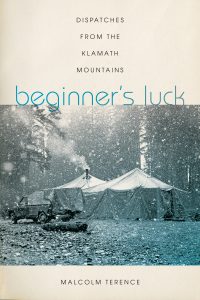
An Interview with Malcolm Terence

Malcolm Terence left his job as a reporter at the Los Angeles Times in the late 1960s and helped found a large hippie commune in the Klamath Mountains. He followed that with logging and reforestation work, setting up–and opposing–timber sales, and fighting wildfires.

Along the way, he married a local schoolteacher and raised a family. He still writes for regional papers, teaches, and cultivates a large garden.

Beginner’s Luck is his first book.

Malcolm Terence will be reading and signing books at Bloomsbury Books in Ashland, June 18th, 2018 at 7 pm. It’s free and open to the public.

Ed Battistella: How did you find your way to the Black Bear Ranch in the 1960s? Tell us a little about your background and journey.

MT: When I came to Siskiyou County in 1968, it was not a friendly place to hippies. I’d left the Los Angeles Times where I’d been a reporter and then as business manager for a band of gifted musicians. I traveled with them to shows and recording dates on both coasts, but drifted away when I met the Diggers, a radical theatrical gang in San Francisco. I confess I thought them a little crazy, but when a few of them wanted to start a new commune in the mountains, I jumped in. That year, 1968, was like that. It was a full day’s drive from San Francisco and the last many miles were just the sketchiest of roads. I arrived midday and maybe 20 minutes later two carloads of deputies came in and arrested me. It seems like yesterday, but 1968 was a half century ago.

EB: Tell us a bit about your book Beginners’ Luck, where you tell the stories of commune and the nearby towns.

MT: When I moved to the mountains I figured that news was something that came out of the city halls, the courthouses and the police stations that I’d worked in Los Angeles, so I stopped writing. Instead I learned about goats, firewood and the reality of living with sixty hippies in the middle of nowhere. There was no internet then and not even many telephones, certainly none at Black Bear. But over the years it became apparent that the stories unfolding around me were as important and as gripping as those that had been on my beat in Los Angeles.

EB: What’s the significance of the title?

MT: Specifically it’s from a time when a Native American friend took me to play cards with his friends near the ceremonial grounds. But more broadly, I came in clueless but got by. I got by with the help of the few locals who found us hapless hippies kind of interesting. That’s been my luck all along. I’m grateful.

EB: How did the community sustain itself over the years?

MT: The folks at the commune gardened, of course, but that was seasonal. Some people qualified for welfare payments, what they call TANF nowadays, and shared them. A few people came from wealthy families and their parents might send them occasional checks. We called that stay-away-from-home money. Since we were snowed in every winter in those days, we’d send out a big truck in the fall once or twice to get the winter’s provisions. Huge amounts of un-milled wheat and potatoes, barrels of oil, big sacks of beans. The Diggers still in the City helped with that.

EB: You’ve also been involved with reforestation work. How did that come about?

MT: Some of the commune expates moved to the river towns and started doing jobs planting small trees in the clear cuts where logging had just happened. People liked it because it was seasonal, which left them time for their homesteads the rest of the year. After one season they organized it as an employee-owned co-op.

EB: You were one of the people who stuck it out. How did the community evolve over time? What changes did you see?

MT: I lasted four years at the commune and left when I felt I’d had enough. I tried San Francisco again for a while and also Santa Cruz, but then I returned to the river. I’d had enough of commune life but the little towns along the river, the mix of Native Americans, rednecks, agency people and other hippies had figured out how to get along. They might have doubts about each other, they might harbor reservations, but they made it work, especially when everybody was needed for things like firefighting or opposing the Forest Service policy of herbicide use in the forest.

EB: Do you think that some of these environmental collaborations served as the basis for later cooperative efforts with watershed projects?

MT: It lay the foundations for work later by restoration non-profits and for productive collaboration with the neighboring tribes. Even the Forest Service has signed on. I call that a miracle, given where we started, and salute all our brilliant allies. I’ve been especially impressed by the caliber of our children, both the ones who returned to urban settings and the ones who stayed or who went to college and then came back. They are so much smarter and so much more politically astute than their parent’s generation, my generation. They work with the Tribe, with the Forest Service, with environmental groups and with a couple of powerful restoration non-profits. Early on we elders saw the benefits of getting along with the non-hippie neighbors, but our kids are really good at it. I’m proud of them and awed.

EB:Are there similarities between America today and our country 50 years ago when the commune started?

MT: Some things seem different. People smoke pot openly and men have beards and long hair, but those shifts are kind of superficial. On a deeper level, the country is still drastically divided in culture and politics. There is a crazy war that goes on and on without clear benefits. There are still deep divisions over issues of gender, class, race and much more. There is more poverty and more concentration of great wealth. The government talks democracy, but practices secrecy, corruption and authoritarianism. Is Trump worse than Nixon? We may have been utopians, but we didn’t leave a very perfect world for our kids. Still, if we hadn’t done the work we did, culturally and politically, it would be even worse. I remain an optimist.

EB: Thanks for talking with us. Good luck with your book.

MT: I hope you find it interesting.

Posted in Ideas and Opinions, Interviews | Comments Off on An Interview with Malcolm Terence

Snow Speech: The Evolving and Combatting Dialects of Ski and Snowboard Culture, a guest post by Brian Wood

Brian Wood is an English major and skiing addict studying at SOU. His two great loves are prose and powder.

Anyone who has found themselves on a ski lift listening to their neighbor describe how they[1] “sent it off a gnar cornie, pulled a triple-cork, just missed the death cookies, and stomped the landing with steeze” probably understands that skiers and snowboarders possess a unique lingo largely unintelligible to outsiders. As in many sports, technical terms and esoteric descriptions pepper the speech of snow sports enthusiasts, transforming their casual banter into a language sometimes barely recognizable as English. However, the linguistics of skiing and snowboarding differ from the majority of sports dialects in two key points.

First, while most American sports’ lingos consist primarily of English terms coined to more precisely describe sport-specific actions, skiing/snowboarding speech embodies an amalgamation of English, Norwegian, and German terminology. To master ski/snowboard jargon—and indeed, to comprehend almost any conversation on or about a ski slope—one must understand expressions derived from all three of these languages, as well as some French, Russian, and Finish additions. Second, the language of skiing and snowboarding departs from more uniform sports’ vernaculars in the cultural rift splitting the dialect. The counter-culture, punk- and gangster-influenced lingo of snowboarders—and recently, some young freestyle skiers—exists in overt rebellion to the ordered, establishmentarian speech characteristic of skiing. This ongoing cultural power-struggle, in addition to the dialect’s diverse linguistic roots, gives the lingo of skiing and snowboarding a depth, nuance, and complexity unparalleled by more single-faceted sports.

Just as the sport of skiing traces its earliest roots to stone paintings in Norway, Herbert R. Liedke recognizes in his paper “The Evolution of the Ski-Lingo in America” that, “Norwegian has contributed the fundamental ski terms to the American ski language” (Liedke 116). Likewise, in his essay “The Language of Skiers,” Horst Jarka affirms, “The first [skiing] terms to be found in dictionaries are, like the word ski itself, of Scandinavian origin: Christiania (long since Anglicized to Christie, -y), ski joring, skiöjoring, slalom, and telemark” (Jarka 202). Despite Norway’s responsibility for the existence of skiing lingo, however, American English speakers initially resisted the adaptation of Norwegian terms into their skiing lexicon.

Throughout the 1800s, Americans preferred to clumsily lump skis in with the English ‘snowshoes’ rather than accept the more precise Norwegian term (Liedke 117). Additionally, some American skiers, such as those in California’s Sierras in the 1860s and ‘70s, invented their own terms for the sport. Sierra skiers devised “such picturesque word creations for skis as: flip-flops, or wooden-wings or, simpler, snow-gliders and wooden sticks” (Liedke 117). These coinages, while commendable in their ingenuity, failed to make a lasting impact on ski lingo. Even after skiing’s popularity exploded going into the nineteenth century, spurring a burst of corporate attempts to articulate the sport to potential customers, the search for English ski terminology still yielded unsatisfying results. Exclusively English ski lingo proved clumsy and inefficient at best, misleading at worst: “an awkward and unskilled mode of describing skiing” (Liedke 117).

By the early 1900s, American skiers and ski marketers had begun to recognize the need to blend English ski expressions with the more accurate and elegant alternatives offered by European languages. Motivated by linguistic necessity, the excellence of German skiers and ski technology, and a growing number of ‘jet set’ American families with a taste for extravagant European ski vacations, English ski vocabulary began to give way to an influx of European—particularly German—terminology. Jarka asserts, “the German element in the language of skiers soon outweighed that of any other foreign language…used not only by American theoreticians and instructors but also by ski fans who want to show how much they are ‘in the know’ on the art of skiing.” He lists a variety of German words incorporated into English ski vocabulary, including ‘fallinie,’ ‘vorläufer,’ ‘girlande,’ ‘riesenslalom,’ ‘schneepflug,’ and ‘treppenschritt,’ which evolved into the English adaptations ‘fall line,’ ‘forerunner,’ ‘garland,’ ‘giant slalom,’ ‘snowplow,’ and ‘stair step’ (Jarka 202-203). These terms, Jarka explains, are literal translations of the German, or loan translations, as he refers to them. Other German words, such as ‘mogul’—a term for bumps caused by heavy skiing on a particular slope—interlaced with English ski lingo without any change at all.

With the adoption of extensive German terminology into skiers’ jargon, the skiing lingo began to develop into a unique mode of speech, a language distinct from Norwegian, German, and English. In addition to loan translation and verbatim usage of German, Norwegian, or French words, the sport produced words exclusive to the world of skiing. Jarka references ‘skiable,’ ‘skimanship,’ and ‘skithievery’ as examples of skiing lingo’s departure from any single language, and points out, “skiers have added new meanings to words like bathtub, bunny, doughnut, eggbeater, snowplow, T-bar, and tow, and coined new terms like dope slope and slope fashions” (Jarka 204). Additionally, Liedke demonstrates skiing lingo’s burgeoning unintelligibility to non-skiers of any language or nation, quoting a ski reporter from the New York Times as proclaiming, “Such expressions as ‘geländesprungs, schusses, slalom, tailwagging and langlaufing’ are heard and you realize that, in addition to learning how to ski, you must learn to speak a strange language” (Liedke 120). As both Jarka and Liedke recognized, the language of skiing had outgrown the constraints of a single place or national identity, evolving into an entity tied exclusively to the experience, the mountain, and the exhilaration of hurtling downhill over snow.

Mirroring the journey of ski lingo into linguistic distinction and legitimacy, skiing also developed a unique culture: one stepped in affluence, prestige, and exclusivity. In stark difference from the sport’s Norwegian genesis as a practical and universally-accessible means of transportation, skiing in the 1900s on catered almost entirely to the upper classes, and the language of skiing expressed this elitism. The practical impossibility of skiing on a budget, coupled with the insidious classism prevalent in ‘ski biz’ advertising, cultivated a strong “snob appeal of…skier’s language” (Jarka 203). Skier speech became a privileged dialect, a syntactical assertion of wealth and cultural capital, and skiers utilized the complexity and multi-lingual nature of their lingo as a barrier to outsiders of lower class or economic means.

Even for those accepted into the prestigious inner circle of skiing lingo, slope speech tended toward a strong focus on order, adapting driving and traffic terminology to stifle freedom of expression or recklessness in skiing. While many of these terms inevitably stemmed from necessity as the skyrocketing popularity of skiing led to increasingly crowded slopes, some phrases—such as the epithets utilized to chastise and demonize reckless or aggressive skiers—demonstrated a clear dedication to structure, principle, and restraint on the mountain. Jarka demonstrates the antipathy faced by skiers who resisted the order imposed on their sport, listing various punitive labels imposed on high-speed skiers: ‘schussboomers,’ ‘hot rod skiers,’ and ‘trail hogs’ (Jarka 204). Additionally, he references an article which, in its title, posits the question “Can Schussboomers be stopped?” As do the derogatory terms of most cultures and languages, these labels for reckless skiers demonstrate the values of skiing lingo through the language’s choice of opponent. By vilifying those (usually younger) skiers eager to push the boundaries of the sport, the skiing language of the 1900s embodied a foundation of support for social and linguistic establishment—a support that grew so pervasive as to invite almost inevitable rebellion.

The revolution against skiing’s establishment culture emerged with the introduction of snowboarding: a sport which, while not significantly different from skiing in a technical sense (skiers slide down snow on two planks, snowboarders on one), embodied skiing’s collective cultural Id. While skiing society supported social values of order structured to maintain the status que, snowboarding championed individual expression, unapologetic pursuit of adrenaline, and strong counter-culture ideologies. In her article “What Is So Punk About Snowboarding?,” Rebecca Heino asserts, “snowboarding is aligned closely with surfing culture…Both blend the creativity of movement with the beauty of nature and the thrill of vertigo, a flirting with danger” (Heino 182). Heino continues, “Snowboarding represented a resistance to materialism and separation of mind and body, while embracing a wholistic view of nature that was similar to Zen and Buddhism” (Heino 183). This stark conflict in worldviews gave snowboarding the fuel to instigate a linguistic revolution.

In order to differentiate from mainstream ski culture, snowboarding lingo drew inspiration from other counter-culture movements. Heino explains, “Instead of the snowboarders aligning themselves with the dominant ski culture, they presented their cultural roots in surfing, skateboarding, and the ‘gangsta’” (Heino 178), and this cultural rift led “Snowboarders [to clash] with skiers in style of dress and body presentation, equipment, and language” (Heino 178). Perhaps the most fundamental linguistic divergence of snowboard culture from ski culture arises in the description of the sport itself. As Heino addresses, snowboarders did not ‘ski,’ but rather adopted the surfing term ‘shred’ into a mountain context (Heino 180). Heino elaborates, “Snowboarding appropriated other words from skateboarding and surfing such as goofy footed (riding with your right foot in front) and sick (excellent, as in ‘That was sick air’)” (Heino 181), resulting in a snowboarding lingo far more easily recognizable to the youth counter-culture of surf and skate groups than even the most linguistically well-versed mainstream skier.

In addition to surf and skate vocabulary, snowboarding also derived strong linguistic influence from gangster culture. As Holly Thorpe observes in her article “Embodied Boarders: Snowboarding, Status, and Style,” “The snowboarding media blatantly appropriate this gangster lingo, writing text in colloquial language and terminology that only gangsters and snowboarders understand” (Thorpe 189). Thorpe offers an example in Transworld Snowboarding, a popular snowboarding magazine and website which “writes to ‘all you fresh-ass mofos out there’” (Thorpe 189).

The incorporation of gangster lingo into the snowboarding lexicon differs from that of surf and skate culture, however, in that gangster terminology offers virtually no practical use in describing the act of snowboarding. Instead, snowboarders draw an exclusively stylistic and ideological connection between their sport and gangster culture, appropriating gangster terms to synonymize the snowboarding lifestyle with aggression, rebelliousness, and masculinity, despite the lack of physical or technological similarity. As Kristin L. Anderson affirms in her piece “Snowboarding: The Construction of Gender in an Emerging Sport,” snowboarding’s gangster speech is both a cultural statement and an intimidation tactic. Anderson argues, “Because the physical practice of snowboarding does not require obvious strength, violence, and aggression, snowboarders must use other factors, such as language, fashion, and ‘attitude,’ in creating a masculine identity…Like the African American men who create a ‘cool pose’ masculinity” (Anderson 69). Therefore, what skiing lingo accomplishes covertly through the underlying themes of prestige, exclusivity, and class distinction associated with the sport’s European technical terms, snowboarding language achieves more bluntly, and in the opposite direction, though gangster lingo. Both skiing and snowboarding adopt specific linguistic and dialectic terms to send a cultural message; snowboarding, true to form, simply refuses to apologize for doing so.

Despite a foundation of antipathy, however, skiing and snowboarding dialects have increasingly begun to merge as snowboarding gains cultural acceptance and joins the ‘mainstream’—a phenomenon highlighted by snowboarding’s presence in the Olympics, and one which has inspired some counter-culture devotees to strap into the once-maligned skis. Heino quotes the Transworld Snowboarding’s managing editor as admitting, “Skiing is punk again. The opposite of what convention is” (Heino 185). Consequently, terms once exclusive to one lingo or the other are being shared: skiers can now ‘shred the pow’; snowboarders can race ‘slalom’ and ride ‘moguls.’ The two once-distinct languages are gradually merging into one. Whatever the future of ski and snowboard speech, however, these lingos have achieved remarkable complexity, originality, and cultural relevance for two dialects founded around skidding down snow on planks, and they show no signs of slowing down.

Works Cited

Anderson, Kristin L. “Snowboarding: The Construction of Gender in an Emerging Sport.” Sage Journal of Sport and Social Issues, vol. 23, no. 1, 1999, pp. 55-79. http://journals.sagepub.com/doi/abs/10.1177/0193723599231005

Heino, Rebecca. “What is So Punk about Snowboarding?” Sage Journal of Sport and Social Issues, vol. 24, no. 2, 2000, pp. 176-191, doi.org/10.1177/0193723500242005. Accessed 19 Feb. 2018.

Jarka, Horst. “The Language of Skiers.” American Speech, vol. 38, no. 3, 1963, pp. 202–208. JSTOR, www.jstor.org/stable/454100. Accessed 18 Feb. 2018.

Liedke, Herbert R. “The Evolution of the Ski-Lingo in America.” Monatshefte Für Deutschen Unterricht, vol. 35, no. 3/4, 1943, pp. 116–124. JSTOR, www.jstor.org/stable/30169965. Accessed 19 Feb. 2018

Thorpe, Holly. “Embodied Boarders: Snowboarding, Status, and Style.” Waikato Journal of Education, vol. 10, 2004, pp. 181-201. http://www.wje.org.nz/index.php/WJE/article/view/339. Accessed 19 Feb. 2018
  1. I use the singular ‘they’ intentionally in this essay in an attempt to avoid gendered speech.

Posted in Ideas and Opinions, Language | Comments Off on Snow Speech: The Evolving and Combatting Dialects of Ski and Snowboard Culture, a guest post by Brian Wood

An Interview with Becky Robinson of Hometown Reads

Hometown Reads! helping them connect with readers in their hometown through what we call the Read Local movement. Founded in 2016, the organize authors by local community.

Hometown Reads is sponsored by Weaving Influence, a full-service digital marketing agency founded by Becky Robinson.

Ed Battistella: What is Hometown Reads?

Becky Robinson: Hometown Reads is a collaborative community dedicated to serving local authors across the country, by helping them connect with readers in their hometown through what we call the Read Local movement. We provide a free online digital bookshelf, where authors can showcase their books for increased discoverability.

EB: How long has Hometown Reads been doing this?

BR: Hometown Reads launched its first city, Toledo, Ohio in 2016. We celebrated our two year anniversary as a company in March of 2018.

EB: What is the benefit to authors?

BR: Hometown Reads allows authors a free platform to showcase their works amongst others in their hometown for exposure locally (and even globally).

We promote our authors across social media and have created tweets for authors to cross-promote each other and their locations. Each location has a city-specific Facebook group and author-Ambassadors to help grow the Read Local movement in their hometown, as well as share best practices for book marketing.

EB: Are there services for readers who are not authors?

BR: Our site is designed so that readers can search and find both books from their hometown, paired with the hope that they can develop online or in-person connections with their favorite hometown authors. Readers are also able to search by location, genre, and featured books.

EB: How do you pick the towns?

BR: Some of the locations we showcase were suggested by authors, local bookstores, or publishers. Other hometown locations were added when we notice an influx of authors signing up in a particular area. We are always looking for new locations and are open to suggestions.

EB: Are libraries and bookstores involved? How so?

BR: We encourage libraries and bookstores to sign up as Read Local Champions. These community organizations are supporters of the #ReadLocal movement in their hometown. We showcase them on our website and encourage them to implement “Read Local” shelves to support awareness of the local authors in their hometown.

EB: Who sponsors Hometown Reads?

BR: Hometown Reads is sponsored by my core company, Weaving Influence. Weaving Influence, based in Lambertville, Michigan, partners with authors and thought leaders to grow their online influence and market their books. It has grown into a team of more than 30 skilled professionals, offering full-service traditional publicity services and website development, in addition to our social media work and book launch promotion. We currently serve more than 40 clients and have launched more than 100 books since our start in 2012, with more planned for this year. While we primarily serve authors and thought leaders, we also work with corporations, small businesses, and nonprofit organizations.

EB: What are your plans for the future?

BR: We want to continue increasing the number of locations we represent to gain more attention of readers. We plan on launching a new homepage and book page designs in 2018 to make the site more attractive to readers. We want to continue exploring meaningful relationships with Read Local champions, facilitating involvement from our Ambassadors, and finding new, innovative ways to support our local authors.

EB: Thanks for talking with us.

BR: Thanks for your support of Hometown Reads in Ashland!

Posted in Interviews | Comments Off on An Interview with Becky Robinson of Hometown Reads

The Evolution and Importance of Angloromani, a guest post by Sarah Sissum

Sarah Sissum is a member of the Honors College at Southern Oregon University, where she studies English and History.

Angloromani is one of the numerous Para-Romani languages existing in traveler communities today. Characterized by its usage of Romani terms, the language reveals many elements of Romani culture and history. The exclusivity of this community, though, has made studies of the language a challenge. Romani linguists such as Ian Hancock have synthesized the relationship between English and Romani. Much of what is currently known comes from studies of Angloromani’s phonology and grammar. Most importantly, these linguists stress the necessity of the Romani language in the preservation of their culture. This essay will look at the history of Angloromani, its composition, and the cultural ties between the Romani people and their language.

The first step in understanding Angloromani is being able to trace the Romani people to their point of origin. The Romani people, often referred to by the misnomer gypsy, are believed to have migrated from India sometime around 1000 A.D. (Fraser 18). This inference comes from the presence of similar words in both Romani and several Indian languages, such as the word pani, which means ‘water’ in over fifty Indian languages and in Romani (Hancock 9). In the same way that linguists have been able to establish an Indian origin for the Romani, they have also been able to use their language to infer the most likely route of these peoples into Europe. Hancock traces the movements of his people after their diaspora:

The presence of many words adopted from Persian (for example, baxt ‘luck’) and some Kurdish (vurdon ‘waggon’) show that the migration must have passed through Iran; Armenian and Greek words (such as kočak ‘button’ and zumi ‘soup’) show passage through what is now Turkey; Slavic and Romanian words (dosta ‘enough’ and raxuni ‘smock’) indicate a presence in the Balkans (Hancock 9).

After their arrival in the Balkan States, the Romani gradually spread to Western Europe beginning around the 1430s (Fraser 85). Almost immediately, these travelers were met with scorn and accusations of espionage, as seen in an account by German chronicler Aventinus (Johann Thurmaier) in the Bavarian Chronicle during 1439 (85-86). This marked the steady deterioration of public attitudes toward the Romani during the fifteenth and sixteenth centuries (86). These sentiments would set in place a tradition of prejudice towards the Romani that exists to this day.

Like any society, Romani culture has played a significant role in the formation and spread of their language. Since their initial diaspora from India, Romani travelers have tended to be an exclusive group. Non-Roma’s, known in Angloromani as ‘gåja’s,’ have traditionally not been admitted into traveler communities. Byzantine Greeks referred to the Roma as ‘Tsingani,’ which roughly translates to the ‘don’t touch’ people (Hancock 1). As a result, those limited few who have had contact with the Romani, such as George Borrow, a 19th century English novelist who wrote multiple pieces describing Romani vernacular, have been highly prized for their insight into traveler culture. Even those outsiders who have gained acceptance, though, are seldom exposed to Romani in its entirety.

In addition to the obstacle posed by limited contact with travelers, a lack of literature has made it even more of a challenge to study Romani culture and language. Romani has existed as a language written by Romanies since the early 1900s (Hancock 139). Consequentially, roughly nine hundred years of Romani culture has passed solely though an oral tradition. The most prolific studies of Rom culture have occurred sparsely throughout history, and have been recorded by non-travelers. The first known work on Romani culture was written by Andrew Borde and published in England in 1547 (Fraser 10). His Fyrst Boke of the Introduction of Knowledge contained evidence of ‘Egipt speche,’ which showed borrowings from both Romanian and Greek (10,12). Borde’s work, which claimed that the Romani tongue was Egyptian, attempted to identify Romani as a unitary language. The next text on Romani, Études sur les Tchinghianés by Alexandre Paspati, would not be published until the 1850s, and would examine the presence of Rom travelers in Turkey. Following works on the Romani would place them in Wales and Sweden, with evidence of their movement through Norway, Finland, Russia, th Balkans, Germany, France, and Poland (13). If these texts demonstrated anything, it was that Romani was not a unitary language, and that it had undergone numerous changes by the time it had left India and migrated to Great Britain in the sixteenth century.

The genesis of Angloromani has been debated for nearly fifty years. At the beginning of the 1970s, linguists Donald Kenrick and Ian Hancock offered two very different explanations for the origins of Romani English (the preferred term of Kenrick for Angloromani). Kenrick argued that Romani gradually developed over the 500-year period that the Rom had been in contact with the British (Bakker 15). As a result, their language became progressively more and more anglicized, until it was predominantly English with a Romani lexicon. Evidence from older sources indicate that the language of British Rom travelers possessed more Romani features in its early days compared to where it is at today. Kenrick estimates that the last users of Romani morphology died at the beginning of the nineteenth century, leaving behind only their lexicon for later generations (15-16).

Hancock, however, refutes Kenrick’s theory of gradual transformation with his charge that Angloromani is a creole. His proposal places the origin of Angloromani in the 16th century – immediately after the Romanies’ arrival in England (Bakker 16). Hancock posits that Angloromani formed as a sort of pidgin between the Romani speakers and the Cant speakers (16). Rather than melting into the dominant language, Hancock’s Angloromani separates the travelers from the mainstream culture (Matras, et. al, 4). This variation of Para-Romani establishes a tie between the minority groups of England and the Rom (4-5). The transmitting of Angloromani over generations has, thus, led to the creolization of the tongue (4). Above all, Hancock’s theory gives credence to the British Romani as a self-sustained culture with a language that is not a bastardization of English.

Other theories concerning Anglo-Romani origins tend to fall into either camp. Judith Okely of Oxford University expands Hancock’s creole hypothesis to cover most Para-Romani languages, particularly in instances where different Romani groups are in contact with one another (Matras, et. al, 5). Peter Bakker of the Aarhus University in Denmark, on the other hand, argues in favor of Kenrick’s proposal. His initial argument is that Welsh Romani rapidly converted into Angloromani out of a desire of the people to preserve their traveler heritage. After this point, though, Bakker contends that Angloromani gradually lost its Romani characteristics and became more and more English-heavy (Bakker 28-29). These are only a few of the numerous theories concerning Angloromani – some focusing on the speech as a type of mixed-language, vocabulary retention, or a sort of code for travelers.

Regardless of its origin, Angloromani possesses characteristics from both English and Romani. The language is predominately English with occasional usage of Romani words. Early Angloromani first saw the usage of the indefinite article a, as seen in “av a kušku ýhav,” meaning “be a good boy” (Matras, et. al, 10, 13). By the 1830’s, Angloromani had adopted English function words including prepositions, interrogatives, and possessive pronouns (13). Though Angloromani initially retained much of its original Romani structure, it eventually gave way to a more English structure. This consistent usage of English grammar is referred to as the “new dialect,” while Romani grammar is considered to be the “old dialect” (13).

Angloromani’s phonology largely sets it apart from standard English. While it tends to reflect English phonology in most ways, its variations are often unpredictable and inconsistent. Words may have multiple spelling variations, depending on who is speaking. Take, for example, the Romani word for ‘dog’: džukel. Angloromani has seven recorded forms of the word in its language. These forms include: jakkel, jokkel, jonkul, juggal, juk, jukkel, and yakkal (Matras 99-101) The word for prison in Angloromani has thirteen recorded forms (101). While variations in vocabulary and pronunciation are by no means uncommon within a language, Angloromani exhibits extensive varieties with few discernible patterns. Yaron Matras posits that this variation “is in line with observations on language decline and the relaxation of normative control on the realisation of lexical items and their structural components” (100). This, along with the widespread distribution of traveler communities, has led to a loss of key defining characteristics in Para-Romani languages.

Angloromani phonology contains relatively frequent usage of lenition and fortition. The Angloromani word for ‘blood,’ rati, is often pronounced as radi, with the /t/ morphing into its voiced counterpart, /d/ (Matras 100). Fortition is even more widespread in Angloromani. Iv, the word for ‘snow,’ turns into eef in Angloromani speech. Linguists note that the Angloromani /v/ tends to be quite unstable in speech, taking on either /f/ or /b/ (100). This usage pattern is difficult to track, though, and varies among users. ‘Snow’ in Angloromani, therefore, can either sound like eef or gib (100). Another notable characteristic of Angloromani phonology is the addition of the /h/ at the start of words beginning with vowels. An example of this would be the pronunciation of ‘Irish’ as Hirish (101). This also occurs in Romani terms, as seen when ‘iv’ is pronounced as heef (101). Rather than trying to determine when the /h/ should be pronounced, as in history, or when it should not be pronounced, like honest, the Romani tendency is to always pronounce the /h/. The Rom’s hypercorrection indicates a degree of insecurity attributed to low levels of education and a lack of exposure to institutionalized English (100-101). As such, the Romani are less likely to acquire instruction on standardized forms of English pronunciation.

The last aspect of Angloromani grammar that this essay will focus on is word formation. Angloromani retains a particular suffix –(m)engr- that functions as a common nominalizer. Matras presents five functions of the suffix: instrumental, productive-objective, agentive, descriptive, and associative-figurative (Matras 104). The instrumental usage of –(m)engr- is seen in the word dikkamengri, which means ‘mirror’ in Angloromani. It derives from the word dik, meaning ‘to see,’ and demonstrates how a word can depict an activity coming from its word stem (104). Productive-objective usage creates an object from a depicted activity. For example, chinnamegra, or ‘letter,’ comes from the root word čin, which means to ‘write/carve’ (104). –(M)engr- is usually agentive in cases of professions/occupations born of a certain activity (104). A berramengra is a ‘sailor,’ and comes from the Angloromani word for sailing, which is bero (104). The associative-figurative form of the suffix occurs when there is a direct link between the created word and the term that it references. Kannegras are ‘hares,’ and are known for their large kans, or ‘ears’ (104). The last form of –(m)engr- involves the application of multiple descriptors to the referent. The word balval, meaning ‘wind,’ and phagger, meaning ‘break,’ come together to form windmill, “bavvalpoggermengri” (104).

Perhaps even more pertinent to understanding Angloromani is understanding its usage patterns. Speakers of Angloromani tend to employ the language circumstantially. It often functions as a sort of code for the Romani (Matras 134). Using the language can signal to another person that they are recognized as being part of the “in-group” (134). Angloromani also has a highly emotive quality. In a conversation between Matras and a Romani friend of his, the two discuss the friend’s impending move from a trailer into a house. When Matras asks his friend if they signed the contract for the house, the friend responds that no, they had not signed for the house because they got trashed. In Romani, this word mean ‘to fear.’ The friend’s usage of Romani in this instance is indicative of a much larger fear of moving away from the Romani culture, as the transition from a trailer to a house is often seen as a loss of culture in Romani tradition (135). Even pesky children have been known to employ Angloromani when trying to appease angry parents, knowing the emotional ties associated with Rom culture (136). As Angloromani has virtually no logistic function outside of the traveler community, its usage is an active call to Romani heritage.

Estimating the distribution of Angloromani speakers in the world today is tricky. As of 2007, there were an estimated forty thousand to sixty thousand travelers in Great Britain. This number is made unreliable, though, by its likely inclusion of Irish travelers and Scottish travelers (Matras, et. al, 17). In the select known Romani populations in the United Kingdom, it appears that Angloromani is in decline (18). This does not come as a surprise when one considers contemporary attitudes towards the Rom. To “gyp” an individual is to swindle them out of money. Media coverage of the Romani is rare and seldom positive. In BBC reports of a drug bust from 2011, linguistic analysts were brought in to explain the meaning of certain Romani words in relation to drug paraphernalia (Tarver). The association of Romani with drug crimes perpetuates the stereotype that travelers are untrustworthy by nature. As stated by Ian Hancock, “if Romanies are not held in high esteem, than our language cannot possibly be” (Hancock 140). The future of Angloromani, based on its current state, does not appear promising.

As a language in decline, Angloromani warrants attention in academic settings. The tie between English-speaking Romanies and their ancestral tongue is imperative in their sense of cultural security. The late Matéo Maximoff stated in a 1994 interview that “Wer kein Romanes mehr spricht, its ken Rom mehr” (“whoever no longer speaks Romani, is no longer a Romani”) (Hancock 139). While language is not the sole basis of Romani culture (victims of anti-traveler legislation have often been forced to give up their dialect), extinction of Angloromani contributes to the loss of a vast and elusive history. Recent studies, though, have demonstrated the possibility of preserving Angloromani by legitimizing it in academic spheres. Through a conscious effort, Angloromani may yet survive.

Works Cited

Bakker, Peter. “The Genesis of Anglo-Romani.” Scholarship and the Gypsy Struggle: Commitment in Romani studies, ed. by Thomas Acton, University of Hertfordshire Press, 2000, pp. 14-31.

Fraser, Angus. The Gypsies, Blackwell Publishers, 1992.

Hancock, Ian. We are the Romani people, University of Hertfordshire Press, 2002.

Matras, Yaron. Romani in Britain: The Afterlife of a Language, Edinburgh University Press, 2010.

Matras, Yaron, et. al. “Angloromani: A Different Kind of Language?” Anthropological Linguistics, vol. 49, no. 2, 2007, pp. 142-184.

Tarver, Nick. “Gypsy dialect in the spotlight after Kent court case.” BBC News, 16 September 2011.

Posted in Language | Comments Off on The Evolution and Importance of Angloromani, a guest post by Sarah Sissum