Life is not a game. And, by extension, neither is art.
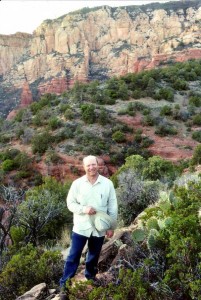
Jonah Bornstein received an MFA in Poetry from New York University and moved to Oregon in 1989, where he co-founded the Ashland Writers Conference. He is the author or co-author of several collections of poetry, most recently Treatise on Emptiness (2009) and his poem “Night Blooming Men” was nominated for a Pushcart Prize.
His other collections include A Path Through Stone and We are Built of Light and the coauthored Voices from the Siskiyous. His poems have been anthologized in September 11, 2001, American Writers Respond (2002), Walking Bridges (2008), and Deer Drink the Moon (2007), among other collections. His poems can be found online at Oregon Poetic Voices and at the Writer’s Dojo. He and his wife, painter Rebecca Gabriel, live in Ashland, Oregon, where he runs Wellstone Press and teaches and edits poetry privately.
EB: What does it mean to you to be a poet?
JB: The poet’s job is to unmask or reveal the world. The irony is that to do so it is often necessary to create masks of language. By this I mean that poems might use images that obscure the every day experience of the world while revealing it. For example, we take a walk along Bear Creek, stop, sit on a log and gaze into the water. Soon we begin to see the trees and clouds above us reflected in the water, thus creating a sense of depth. This is a beautiful and relatively common experience. The poet can do many things with such experiences. What first comes to mind now is the idea that I don’t stop long enough to consider my life, the subtle depths, the detail and beauty I miss by just considering the surface of things, of relationships, of life.
There is a strong push these days for the poet to remove the personal from the poem, replacing it with abstract or obscure notions that reflect, perhaps, the disjointed complexities of life today. I don’t buy it—in fact, the writer’s job, to my mind, is to walk naked in the world or, for the more reserved among us, to unclothe characters to see what lies before and within us. Through such close observation and fearlessness, the poet reveals the reader to himself. Can there be a greater accomplishment or service?
I love to play with sounds and language, with movement and shape. It’s an opportunity for new kinds of explorations, juxtapositions, discovery of new metaphors. But if that’s its end, it is to no end. In my mind there will be no lasting audience for it.
I don’t’ want my audience scratching their heads. I want them saying, “Yes, yes, yes,” “That’s what I’ve been trying to say,” “That’s what I feel. Now I understand.” Or even, “I’m not alone.”
It’s incumbent on the writer to explore the subtleties and power of language, imagery, sound. And idea. Perhaps the reader will discover something new in herself or an aspect of the world not previously considered. The poet expands and extends connections. That’s what language is all about.
Let me be more radical. And precise. Life is not a game. And, by extension, neither is art. Too often I think we in America treat both as such. Should I single myself out? I don’t know. The reader will have to reflect on that. I do know that art can be important. But only if it does its difficult and joyful job of revealing what it means to be human—to exist, to struggle, to love, to hate, to be in pain, to be in joy. To explore the world we live in. And to examine ourselves. To be a poet is to peel back the tough skins of experience. It is to see within and without and to help or invite the reader to do the same. Art, surely, can be a revolution.
EB: How has being a poet affected your feelings about language?
JB: I’ve already partially answered this question. But it’s a great one, so please allow me to expound. Blake and Walter de le Mare introduced me to repetition, rhyme, and mystery—the pause—the juxtaposition of sounds, cadence. Song. Later e e cummings and Wallace Stevens added to this, revealing the space and silence a poem can make in the mind—the way the world is made of beautiful distances of sound, both inner and outer. Now I try to play sounds off each other. Hard. Soft. The pause. A pause can build a space in the reader, allowing the poem to reverberate in the body. I’m alert to it. It’s like a leaf falling: a slight breeze picks up. The leaf is held in space, trembling, before it is permitted to fall. What I’m trying to say is that language is alive, even on the page. It is as tender and troubling as life. It’s not a bunch of inert shapes, an amalgamation of dots on the page or screen. It must be heard, at least in the mind, to be really felt and understood. This is the listener’s responsibility. Language is what we are made of and I want to pay tribute to it.
EB: When did you first begin writing poetry–and why?
JB: I began writing poetry at fifteen. Poetry and fiction and journals. There were several reasons. The story I usually tell is that I came from a family of visual artists. I couldn’t compete with my prodigy sister, but expression through the arts was the family business. So I consciously chose writing. But the truth, I think, is quite different. William Blake and Walter de la Mare and a bad experience with hallucinogenics led me, along with two friends, to literature as a new step in our adolescent search for meaning. Strange to think this now, but we were already using poetry and other writings as a basis for our truth seeking. We were ambitious, aspiring toward intense lives similar to our heroes: Blake, the English Romantics, the Russian novelists (Gogol, Dostoevesky, Tolstoy), Thomas Wolfe, Dylan Thomas. “Rage, rage against the dying of the light.” The journals attempted to capture every aspect of every day—descriptions of what I saw and felt, smelled and heard. Dreams. I’d jot down conversations and observations of behavior that might inspire stories. Our mutual goal was to capture the world through words and feeling.
EB: How do you write? At a desk? Walking around?
JB: I rarely write at my desk, at least not first drafts. I often begin poems outdoors, often while walking. An image or idea comes. I stop to jot it down. Sometimes I have a voice-activated recorder with me, so I “write” while walking. The stride seems to release the chaos built up from the day’s barrage of stimuli or work. I like to write on benches or sitting by a stream or boulder. Or, in contrast, in coffee houses where the activity and sounds free me from the responsibilities and distractions I might find at home. After the initial draft, I write longhand, usually several drafts, copying and rewriting from one notebook to another, until I feel I have a draft ready to be typed. Once typed, I make notes on the page and rewrite in a notebook and then type again. Rewriting or revision is often the most creative and revelatory aspect of writing. It is when I uncover the image, the movement, the intent. Dig in, move around a word, a phrase, a rhythm that’s too easy. Find the heart of a piece and rebuild the body. Revision may be tough, but for me it is the truest process of discovery and creativity.
EB: Who are your poetic influences? Who are your poetic heroes?
JB: How do I whittle this answer down? For the influences follow me from year to year, decade to decade, sometimes fading for years only to reappear in a new poem or direction. A “brief” list will have to suffice:
Rainier Maria Rilke—the greatest influence on my direction as a poet and person, Rilke moved seamlessly between this world and another he alone occupied, yet managed to remain grounded in an understanding of human suffering and hope. His combinations of idea, lyric, and metaphor are among the most original.
William Blake—my first influence—for the use of rhythm, repetition, creating a design for the poem, and his range: the mix of simplicity and complexity.
Walter de la Mare— his poem “The Listeners” was the first poem I loved. His use tension, mystery, and storytelling in a poem still haunt me.
Shakespeare—the mixture of language and cutting through fear and time to a statement of truth. Such sheer daring, such lessons to all writers.
Thomas Hardy—his use of imagery to elucidate the subtlest of psychological states. Reading him invokes the command: observe, commit, describe. Everyone should develop the patience to read and study his poetry.
English Romantics—for beautiful sound and rhythms, descriptions of nature, the things that root me still.
Whitman—for changing the landscape of poetry (along with Arthur Rimbaud and Baudelaire). Today we take for granted the revolution Whitman began, the ways in which we think about and explore line, image, and idea.
Tu Fu—for use of the declarative and stark, crystalline imagery that cuts through the romanticism of my youth.
Galway Kinnell—for teaching me how to edit and read aloud. He taught me how to trust that my love of language and sound could be used to communicate the idea of the poem.
Sylvia Plath and Dylan Thomas—for fearless use of language and emotion, trusting the music and beauty of image and sounds to drive the poem home, no matter the difficulty and honesty described.
e e cummings—for revolutionizing the use of line, space, breaks, thereby altering the ways we approach and understand language, sound, silence. And his addition of playfulness to the craft.
Virginia Woolf—for teaching me how to harness language (including stream of consciousness) so that it mirrors experience.
Wallace Stevens—the purity of language. He evokes the subtlest of experiences, emotions—similar to but wholly unlike Hardy. Stevens’ imagination and knowledge draw from the upper atmospheres. Astonishing.
Carolyn Forché—her courage, honesty, and purity of phrase demonstrate that the political poem need not be didactic. It can be a reflect the consequence of political/social authoritarianism and violence that the reader feels viscerally.
Kafka and Beckett—these two are my heroes. Neither a poet, they lived in the poetic realm, where imagination is freed from known boundaries, where the word, the image, the description can give rise to new landscapes that reflect the essence of existence. Is their influence reflected in my work? Yes, but rarely in what I share.
And finally, Octavio Paz and Yehuda Amichai—I think both of these poets’ works most completely describe the current global culture. Their ground covers the lyric, the political, the mystical. Theirs is a shattering, beautiful, and revolutionary poetics. And Amachai is still alive.
EB: What are you writing at the moment?
JB: A long poem that combines the global political and social atmosphere of the last 12 years with an intensely personal reflection that takes place over a single weekend. I don’t want to say more than this about it. But I can add that most of my newer poems have acquired a voice and tone that combines a stripped down language that uses declarative statements to push the imagery forward. That’s a pretty abstract statement, so here’s an example composed on the spot:
The storm drain swallows what it can;
the rest I carry with me
into tomorrow. Like most people,
I follow the path of least resistance
while the news sweeps under my feet.
EB: What poetry books should everyone read?
JB: Whitman’s 1855 or 1856 edition of Leaves of Grass; Collected Poems of WB Yeats (I know he wasn’t on my list of influences, but he is essential); The Essential Keats; Octavio Paz: A Tree Within and Labyrinth of Solitude (essays); Shakespeare’s sonnets; Selected Poems of Tu Fu; Wallace Stevens: The Palm at the End of the Mind; Rilke: Duino Elegies in collections translated by A Poulin or Stephen Mitchell.
 Follow


