
 Follow
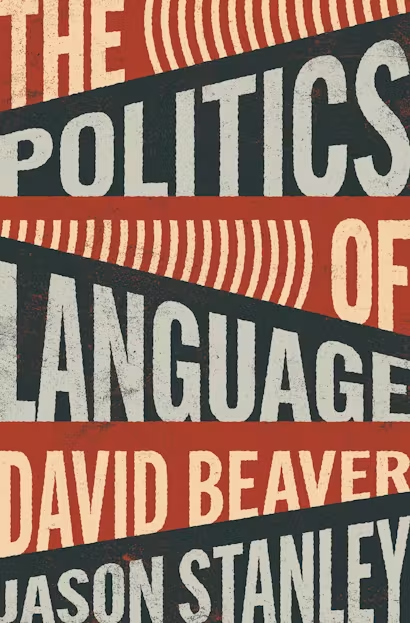 The Language of Politics by David Beaver and Jason Stanley
Around Christmas, I started reading The Politics of Language, by David Beaver (who has authored and coauthored books on semantic focus, logic and visual information, and dynamic semantics and Jason Stanley (of How Fascism Works fame). It an excellent book, though one that is best read in small bites—five or ten pages at a time, and I am reading it that way. I’m about half-way into the book (at page 250, in a chapter titled “On Parole.”)
Here is a progress report on the first five chapters dealing, with how words connect people and with the role of presupposition and its role in ideology. The key argument will be familiar to linguists: speech has meaning that go is imbued with beyond what is being li said and the connotations of words evoke emotions, images and actions in listeners all of which can be manipulated via communication actions that go along with literal talk (what they call “hustle”). In part the book is a critique of the “content delivery model” of communication in favor a viewing communication in terms of speech practices which relate speech to ideology and emotion (e.g. the way in which works in practice evoke feeling). The first three chapter cover the concepts of resonance, attunement, and harmony. Beaver and Stanley discuss language in terms of the resonances, of words (“freedom,” “vermin,” “inner city,” etc. but also of phrases and images), an individual’s attunement to social practices, and to the ways in which systems of attunement change. Chapters 4 and 5 weave in the linguistics of presupposition, giving it a description of in terms of resonances which can transmit and maintain ideology. As they explain it: “The power of political communication rests on its ability to draw attention, drive attunement, and differentiate adversaries.”
While the book has serious philosophical chops (Wittgenstein, Austin, Grice, Stalnaker, Kartunnen, Kaplan, Heim, Saul, and more), Beaver and Stanley have also woven in much research from psychology and sociology (Festinger, Loftus, Kahneman and Tversky, Dan Gilbert, Paul Ekman, Lakoff and Johnson) and from history and literature. Examples are taken from news and current events and ring true.
Princeton University Press has done a fine job producing The Politics of Language (footnotes rather than endnotes) and a helpful glossary of the technical terms. I’ll expand things when I finish the next 250ish pages.
What I’m Reading January 2026
Around Christmas, I started reading The Politics of Language, by David Beaver (who has authored and coauthored books on semantic focus, logic and visual information, and dynamic semantics and Jason Stanley (of How Fascism Works fame). It an excellent book, though one that is best read in small bites—five or ten pages at a time, and I am reading it that way. I’m about half-way into the book (at page 250, in a chapter titled “On Parole.”)
Here is a progress report on the first five chapters dealing, with how words connect people and with the role of presupposition and its role in ideology. The key argument will be familiar to linguists: speech has meaning that go is imbued with beyond what is being li said and the connotations of words evoke emotions, images and actions in listeners all of which can be manipulated via communication actions that go along with literal talk (what they call “hustle”) . In part the book is a critique of the “content delivery model” of communication in favor a viewing communication in terms of speech practices which relate speech to ideology and emotion (e.g. the way in which works in practice evoke feeling). The first three chapter cover the concepts of resonance, attunement, and harmony. Beaver and Stanley discuss language in terms of the resonances, of words (“freedom,” “vermin,” “inner city,” etc. but also of phrases and images), an individual’s attunement to social practices, and to the ways in which systems of attunement change. Chapters 4 and 5 weave in the linguistics of presupposition, giving it a description of in terms of resonances which can transmit and maintain ideology.
While the book has serious philosophical chops (Wittgenstein, Grice, Stalnaker, Kartunnen, Kaplan, Heim, Saul, and more), Beaver and Stanley have also woven in much research from psychology and sociology (Festinger, Loftus, Dan Gilbert, Paul Ekman, Lakoff and Johnson) and from history and literature. Examples are taken from news and current events and ring true.
Princeton University Press has done a fine job producing The Politics of Language (footnotes rather than endnotes) and a helpful glossary of the technical terms. I’ll expand things when I finish the next 250ish pages.
Ghost Month by Ed Lin
Last month I mentioned Ed Lin’s 99 Ways to Die, on of his Taipei Night Market mysteries, featuring Jing-nan who left his dream of an American life to take over this family’s food stand. I read Ghost Month, which opens the series with the story of Jing-nan trying to track down the murderer of his old girlfriend Julia. The wildness of the plot is part of the book’s charm as are the cast of quirky supporting characters and the infusion of Taiwanese culture and lifestyle. A special bonus is the glossary of term about Taiwan at the end of the book.
Cold Victory by Karl Marlantes
A historical fiction set in post-WWII Finland, where two soldiers, a Finnish-American and a Russian take on a cross-country skiing race. Their wives, who have bonded over their become enmeshed in love for French language and culture become enmeshed in politics when the naive American Louise tries to leverage the race to raise money for Finnish orphans. I enjoyed learning about post-WWII Finland, though I thought Louise was almost too naïve to be an attaché’s spouse. Perhaps this was intended in part as a coming-of-age novel. There were some surprises and a sweet ending.
