 Follow
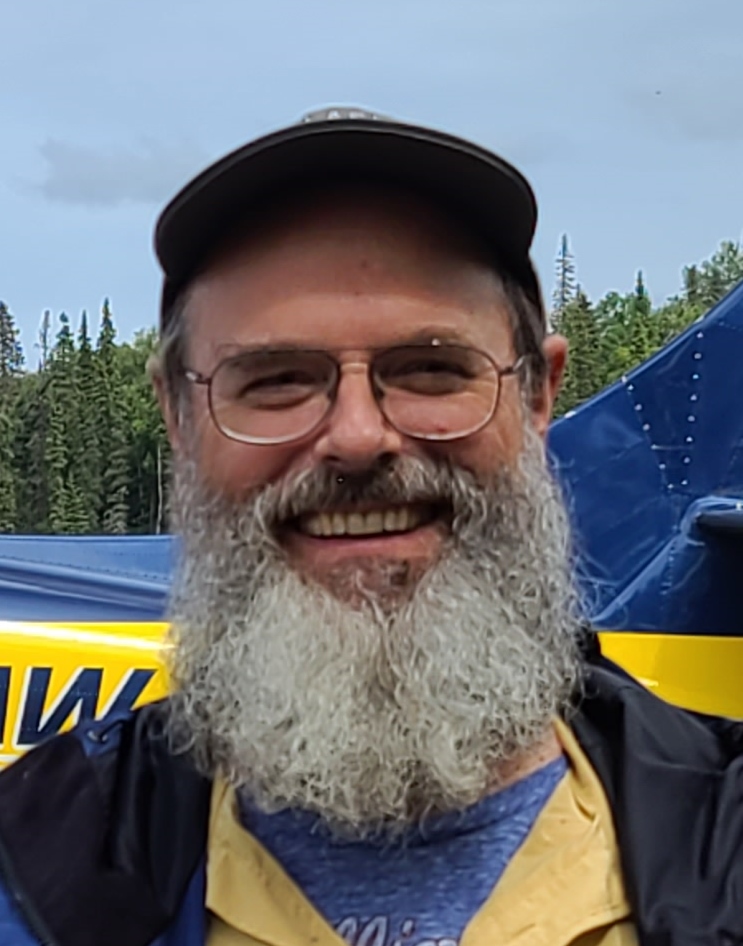 Kemble Yates is from Pullman, Washington. He graduated from the University of Puget Sound in 1982 with degrees in economics and mathematics and went on to earn a master’s degree in mathematics in 1984 and a PhD in 1987, both from Washington State University. His area of expertise is mathematical modeling in biology and astronomy. He has published research on mathematical modeling and has served as an expertise witness in court cases on age discrimination and as a mathematical consultant in industry.
He joined the faculty of Southern Oregon University in 1987 and was promoted to full professor in 1999. He has served as chair of the Math Department from 2003 – 2008. He has also served many terms as a faculty senator and was twice the President of the Faculty Senate and served a term as president of the statewide Inter-institutional Faculty Senate. He twice served as the president of the Associated Professors of Southern Oregon University and was the chief union negotiator several times. From 2003 — 2022, Yates served as the Southern Oregon University representative to Association of Oregon Faculties.
He is an accomplished amateur bridge player.
In 2018, Kemble Yates received the Outstanding Service Award at Southern Oregon University. He retired in 2022.
Ed Battistella: How did you make your way to SOU?
Kemble Yates: As it worked out, I decided late in the 1986-87 employment cycle to look for a job, and only a few universities still had openings. One of those was Southern Oregon State College. I got an interview, and ultimately a job offer. At the time, I was thinking this would be a good “starter job” and I’d move on in a few years. I fell in love with the university and the area, and I really never seriously considered leaving after my first couple of years.
EB: Do you remember what you taught in your first years at SOU?
KY: I taught college algebra, first term calculus, and multivariate calculus my first term. I fell in love with teaching collegiate mathematics in graduate school, and one thing that I’ve really loved about my Southern experience is that I got to teach a wide variety of courses.
EB: What else stands out from your first years?
KY: I arrived the same year a new President, Joe Cox, did. Prior to Cox, a pretty unpopular President (at least to the faculty and staff) had left in a cloud. The university seemed to ride a nice optimistic wave my first three years. Unfortunately, Oregon’s Measure 5 passed in 1990, and higher education funding has been a painful challenge ever since.
EB: What’s been your favorite thing about being an academic life?
KY: Perhaps unusually for a mathematician, I am a people person – I really like interacting with people. The faculty and staff at Southern have always been inspiring to me. And of course, working with bright, (mostly) younger students is a true joy. I really loved being a professor at SOU.
EB: What were some high points of your work at SOU?
KY: As your bio on me points out, I have been very active in the life of the university. Through committees, Faculty Senate, and our faculty union, APSOU, I’ve had multiple opportunities to take part in discussions and decisions which have shaped the university and especially the lives of faculty. And I really enjoyed my colleagues in the Mathematics Department: their dedication to building and improving our curriculum, to helping our students learn and succeed, and to being a supportive team to one another has profoundly impacted me. In my last several years, two major highlights were: I got to help start a graduate program in mathematics, and I was the department point person for guiding senior math majors in their capstone projects.
EB: How did you get interested in mathematics?
KY: My road to a mathematics PhD was actually pretty indirect. My true love as an undergraduate at the University of Puget Sound was economics. My Econ professors gave good advice – they said if you want to pursue a graduate degree, you need to have a solid mathematics background. So I backed into a double major of math and econ. And when it came time to go to graduate school, again my Econ professors suggested getting a Master’s in mathematics before switching to a doctoral program in economics. When I arrived at Washington State as a mathematics graduate student, I was awarded a Teaching Assistantship; this meant I taught one math course per term to “earn my keep”. It was then that I realized I really liked math a lot, and I especially liked teaching math. I never made it back to economics!
EB: You are a live-music aficionado. Who are some of your favorites?
KY: I do in fact love live music. I’m really kind of a mutt – I like many different kinds of music (classical, rock, bluegrass, country). And I love everything from a small club show all the way to a stadium show. I have been to over 600 different live music performances. Some of my favorite shows have been Fleetwood Mac, The Cure, Little Feat, AC/DC, and Roger Waters (of Pink Floyd fame). But over the last five years, I’ve actually “graduated” to 3-4 day music festivals. I just returned from the Northwest String Summit (bluegrass and rock) and two weeks prior, my wife and I attended the High Sierra Music Festival (again bluegrass and rock). Next week I travel to Alaska to attend Salmonfest. And of course we are members of Britt & attend 10-15 shows each summer.
EB: What are your plans, post-SOU?
KY: So I’ve always been good at filling my time, and I’m looking forward to having even more time with which to play. In addition to many live music activities, I will play more bridge (both locally and traveling to tournaments), Diana and I will travel more, and I’m really looking forward to reading more books again. I also have an eye on creating and teaching some OLLI classes, as well as taking a few OLLI classes. We will stay in Ashland – we love this area and our home is definitely here.
EB: Thanks for talking with me. I’m right behind you, retirement-wise.
KY: Thanks Ed! I look forward to your joining me in our post-SOU world!
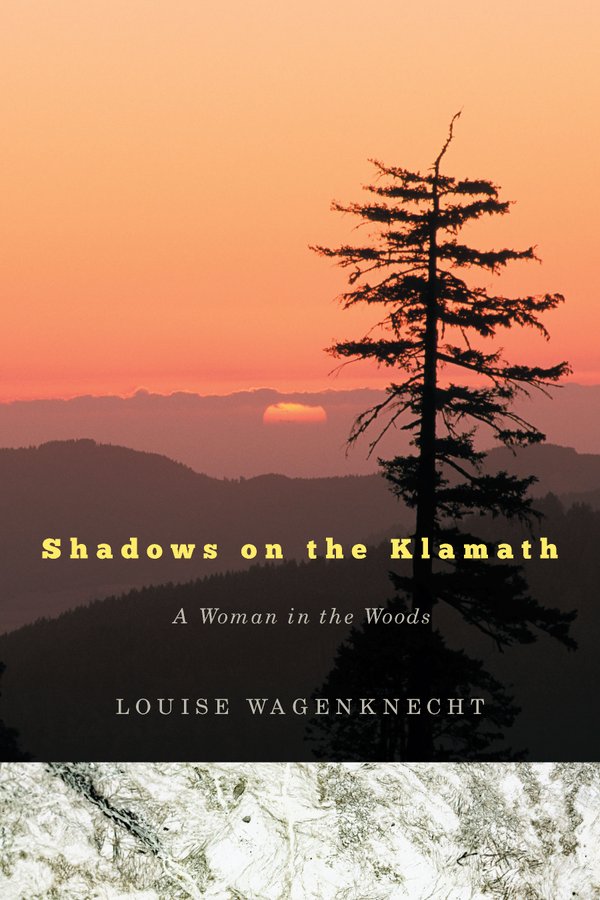 Louise Wagenknecht is the author of a trilogy of books about life in northwest California: White Poplar, Black Locust (2003, republished in 2021), Light on the Devils: Coming of Age on the Klamath (2011), and Shadows on the Klamath: A Woman in the Woods (2021), all available from
 LW: In the beginning, I just concentrated on writing about Hilt. After the first book came out, people started asking me, “what’s next?” and while thinking about what that could be, I started transcribing the diaries I had kept in high school, and by the time I finished, the theme was there: moving from Hilt to Happy Camp was still the same ecoregion, the same natural resource issues still present. Once I carved out the second book, then dealing with the years I worked for the Forest Service, in the belly of the timber beast, so to speak, was the obvious next step. But it still took me a long time to write about it.
 LW: I think I’m more confident now in my ability to just dive right into a story, and more confident that it will interest readers. That was a big hurdle for me with the first book: I knew that I was passionate about this place called Hilt, which was embedded so deeply in me. I couldn’t not write about it, but the challenge was to write well enough for publishers and readers to be interested. As far as style goes, I think I’m now better about cutting, and then cutting some more, than I used to be.
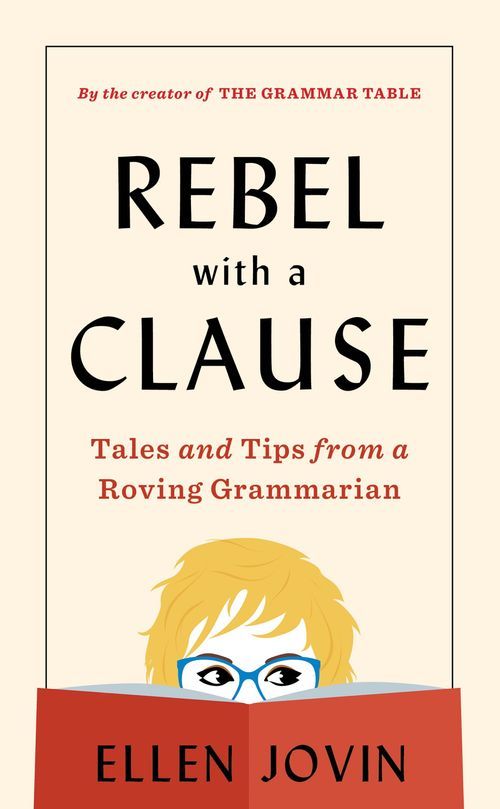
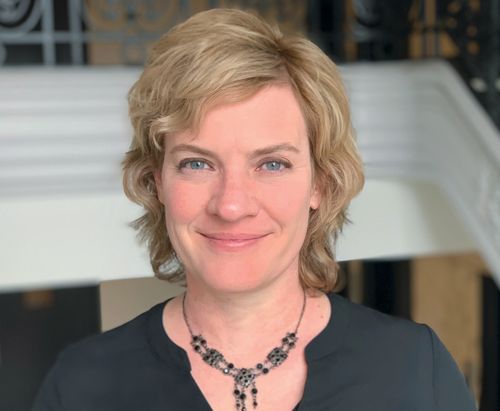 Ellen Jovin has a B.A. from Harvard College and an M.A. from UCLA and has studied twenty-five languages for fun. Jovin is a cofounder of
  EJ: The field of linguistics has had an effect on popular attitudes toward grammar. More people understand that a language is neither monolithic nor immutable. You have less of the “This is how it has to be” attitude,” and often people I encounter have heard of prescriptivism and descriptivism. Those weren’t terms I knew when I was in school. Also, the underlying philosophy of the Grammar Table matters. If I approached the subject as a grammar snob, people would feel intimidated, or angered, or put off. And if your discussion of, say, colons is as much fun as a colonoscopy, it will not get a great response either. To me, participles are like a party, and language variety, while maybe not the spice of life, is a spice of life. We play with language at the Grammar Table. It’s a grammar party! And parties are unifying.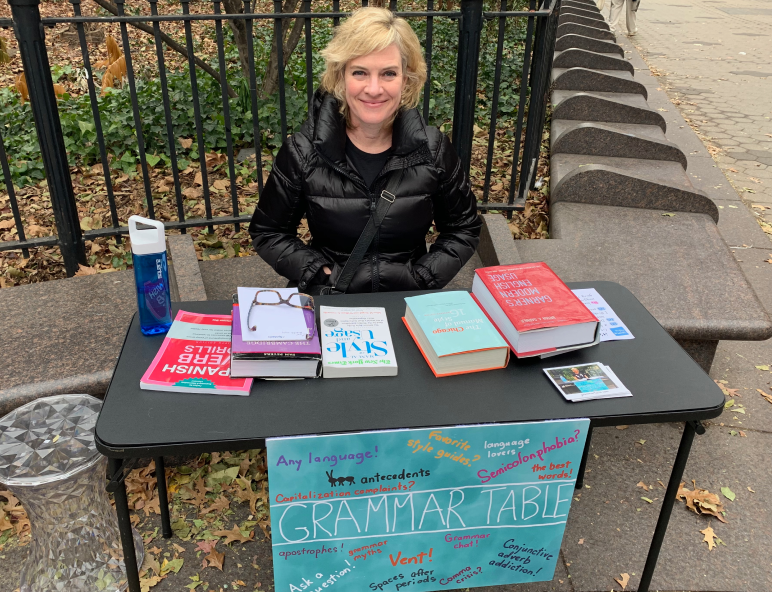
 Coffee houses are known today as places for first dates and novel writing, but their history is much more politically radical. Originally popularized in the Middle East during the ottoman empire, coffeehouses quickly gained a reputation as spaces for political debate and social interaction between classes. Coffee houses were similarly adopted by intellectuals and political revolutionaries in Europe and the United States. Though originally controversial, the increased commerciality of coffee houses and the growing popularity of online spaces for debate has led to a more subdued atmosphere in modern coffee shops. The association with academics and informal social conventions has remained, however. Where historic coffee houses were known for their lively debates and political nature, modern coffee shops have become a haven for uninterrupted study and comfortable conversation.