An Interview with Valerie Fridland, author of Why We Talk Funny

Valerie Fridland is a professor of linguistics in the English Department at the University of Nevada, Reno and the author of Like Literally Dude: Arguing for the Good in Bad English and the 2026 release Why We Talk Funny: The Real Story Behind Our Accents. Her work explores how social changes, linguistic forces, and psychological tendencies reshape our language over time, impacting the way we think about and talk to one another.

​​​Among other things, Fridland is a two-time National Endowment for the Humanities fellow and the recipient of the Linguistic Society of America’s Linguistics, Language, and the Public award, She writes a monthly blog on language-related topics for Psychology Today, is a regular guest writer for the popular Grammar Girl podcast, and has a lecture series, Language and Society, available with The Great Courses. She has appeared as a language expert in a variety of media outlets such as NPR, Armchair Expert, NBC, The Washington Post, the New York Post, the Wall Street Journal, and the New York Times.

EB: I really enjoyed Why We Talk Funny. Can you tell us why you wrote it?

VF: So happy to hear that! I wrote Why We Talk Funny because my parents were French speaking immigrants and, when I was a kid, I was hyper aware of the fact that there were not many other people who sounded like them in my hometown of Memphis, Tennessee. Everywhere we went, my parent’s accents were noticed and, as a result, we were treated a bit differently. As a child, feeling different is the last thing you want, but it really highlighted for me how important accents are to our identities and how others perceive us. This realization led, years later, to my interest in sociolinguistics, or the way that language and social life interact. Also, given the South’s own famed accent, there was a lot of awareness about accents more generally (or at least discussion about why Yankees sound funny), so I guess I had a lot of accent-oriented angst in my early life.

EB: Who is your book for? Who is the target audience? Who should I give a copy to?

VF: If you know anybody with an accent, this is the book for them – which means everyone since of course we all have accents.

I wrote this book specifically for non-linguists because there is so much rich history and science behind the reasons we sound the way we do and it is rarely unpacked for those who don’t work in speech science, cognitive psychology or linguistics. But it is so important to understand not only why we speak with accents but also how we hear with accents as well, because there is very little we do in life where the way we say things or hear things doesn’t matter.

EB: Part of the book gives the origin story of English in Britain and of language more broadly. But you also tell readers about your origin story as a linguist. How does one become a linguist?

VF: I think my early formative years as a child immersed in accents both foreign and Southern unconsciously primed me for a linguistic future, but I pretty much fell into linguistics as a field because I was a Chinese language major in college and had to take linguistics courses as part of that program. One of the early courses I took focused on the language of social life where we covered things like whether men and women differ in the way they talk and how age and ethnicity affect the linguistic choices we make and I was completely hooked. But to be a sociolinguist, you typically need an advanced degree, so I went on to get a PhD in linguistics. My first job after graduation was in Istanbul, Turkey as a visiting professor, where I was amazed at how people could tell that I was American from just hearing me say “Merhaba,” i.e., “Hello.” Accents at work again!

EB: One of your sections dealt with intrusive-r in warsh, which I have in my speech, off and on. What’s the story there with r?

VF: I love that you say “warsh” sometimes, as it is a receding feature, meaning that people don’t say it as much anymore as they used to. This pronunciation is a bit mysterious, since the ‘r’ is inserted into words where it doesn’t historically belong. It seems to be related to early colonial days when the “ah” vowel was pronounced with a bit more lip rounding than it is today, especially in the Mid-Atlantic colonies. Particularly before the “sh” sound, which involves the front of the tongue lifted toward the little ridge behind your teeth that you burn when you eat pizza, a rounder lip can cause the tail end of the vowel to sound a bit like an “r” sound. Thus, you get words like “wash” or “squash” that sounded more like “warsh” or “squarsh.” Since spelling was not tops on anybody’s list at a time when people were both likely to be illiterate and more concerned with surviving illness, conflicts, and starvation, the pronunciation stuck around – at least until greater familiarity with spelling became more influential on how people spoke.

In a slightly different version of an intrusive “r,” sometimes “r” gets inserted where it doesn’t historically belong in words like idea (e.g., “idear”) or law (“lawr”) because of the influence of a different process called “linking ‘r’.” This version applies mainly to cases where speakers don’t typically pronounce all their “r” sounds, as in some dialects of British English, and is a bit more complicated in terms of when and why it happens. The story of how we say (or don’t say) our “r” sound is one of the most fascinating tales in the book and it really illuminates how social triggers like migration, revolution, and changing ideology deeply impact the sounds we say.

EB: I have never thought about the aesthetics of accents and so I especially enjoyed the section on that topic. What makes a language or an accent beautiful or ugly?

VF: I think we all have a language that we have a bit of a crush on – one that appeals to us even without understanding a word and one which makes speakers seem just a tad bit sexier. Rarely, though, do we spend much time wondering what makes for a love language, linguistically speaking. Luckily, researchers in an area called “phonoaesthetics,” or the study of the intrinsic beauty of sounds, have spent some time on this question. They have found a number of factors explain linguistic attraction. For one, languages with more open syllables, like “ta” or “la,” tend to be preferred, as well as those where sonorant sounds are more frequent, a category which includes all vowels and the sounds “l,” “r”, “m,” and “n.” One reason these features might be appealing is because they make a language sound more melodious and musical – in other words, they are more singable. The Romance languages, ones like French, Italian, Spanish and Portuguese, use more open syllables and sonorant sounds compared to Germanic languages like English, German, or Dutch, which might explain why Holy Roman Emperor Charles V claimed that he “spoke Spanish to God, Italian to women and German to his horse.”

EB: What’s your favorite odd fact about accents that you didn’t put in the book?

VF: One fact that didn’t make the book but I find fascinating is that there are some anthropologists and linguists, particularly those who are trying to trace the evolution of language in pre-history, who found that languages became less phonemically complex – or lost sounds – as they dispersed from the original source language in Africa some 50,000 or so years ago. For instance, some African languages, particularly click languages, have sound systems that number over 100, while most European languages, including English, have far fewer, around 30 to 40. This mirrors what has been found with genetic diversity, which also seems to have decreased with distance from Africa. However, this is still controversial as it is hard to really pinpoint anything about languages that no longer exist and for which we have no records.

EB: Thanks for talking with us.

VF: Sure. Thank you for the chance to chat a bit about Why We Talk Funny!


Posted in Ideas and Opinions, Interviews, Language, What People Are Reading | Comments Off on An Interview with Valerie Fridland, author of Why We Talk Funny

An Interview with Renee Owen, author of Becoming a Transformative Leader from the Inside Out

Renee Owen is an associate professor in the SOU School of Education and the co-author of a recently released book titled Becoming a Transformative Leader from the Inside Out (Bloomsbury Publishing, November 2025). Owen earned her bachelor of fine arts degree at the University of Michigan, a master’s degree in Educational Leadership at the University of Colorado, Denver, and a doctorate in Organizational and Adult Learning and Development from Columbia University Teachers College.

Owen is the executive editor of the Holistic Education Review and she coordinates the Principal Administrator Licensure program at SOU. Together with co-author Christine Y. Mason, an educational psychologist who is an assistant clinical professor in the department of psychiatry in Yale University’s school of medicine, Owen developed an educational model aimed at helping new and veteran teachers to shape schools as more positive influences.

Ed Battistella: Congratulations on your book. Can you tell us a bit about how the book come about?

RO: Becoming a Transformative Leader from the Inside Out is a book I’ve been wanting to write for quite some time. I was a school leader for 22 years at unique schools that found success in unusual ways, and to an extraordinary degree. I think part of that success came about because I wasn’t originally trained as an educator, so I didn’t think within that “box.” The first school I led was a high-poverty project-based charter school that I founded in rural Colorado, where I was living with my young family. Since I had no training in education or in leadership, I educated myself mostly with leadership books intended for corporate executives. That was a completely different approach to leadership than education takes – far more agile and adaptable. I applied what I was reading, partly out of ignorance of what a typical leader groomed in K12 education would have done. Sometimes ignorance really is bliss. Much of what I did was risky, but I didn’t know the difference at the time. And while I made a lot of mistakes, the overall results were beneficial.

As time went on, I wanted to write about my leadership experiences in the hopes other leaders could learn from a unique approach to leading schools…but I couldn’t carve out enough time to write a book while I was running schools. Too busy. Then, when I took the position at SOU of running the administrative licensure program, I wanted to write the book even more, because I couldn’t find the book that I wanted for my program. So I had to write it myself! Fortunately, I knew Chris Mason, my co-author, who has published a lot of books, to help me through the writing and publishing process.

EB: One of the things you discuss is transforming the industrial paradigm. What is that paradigm?

RO: A paradigm in this case could be defined with several other words–worldview, frame of mind, and ontology, to name a few. It’s a way of being that is typically so ingrained in a people’s culture and society that most people don’t even question it.

I describe the industrial paradigm as a hierarchical system that values efficiency and productivity over relationships, interconnectivity, and sustainability. Communication flows from the top down, and resources from the bottom up, with those at the bottom benefiting those at the top more than the other way around. The system is, by nature, exploitative of humans and natural resources. Most Americans think of this system as normal, or “just the way it is” (If they even stop to think about it at all.) That’s because the system, or paradigm, we live in also shapes the way we think and behave.

Students are naturally at the bottom of this system, with the least power of all. Schools in the industrial paradigm are set up for efficiency, with students treated as a future resource for the economy – a resource that needs to be shaped to be of value. Most teachers, of course, don’t explicitly think of it that way, and might be appalled at my accusation. In my early years of education, when I worked primarily with kids in a high-poverty situation, I viewed my efforts to teach them the grammar – not just of the English language – but of the industrial system. I was helping them to rise up through the system. I wanted them to be able to compete.

But if everyone is competing with one another, that isn’t sustainable. There are always winners and losers.

Now I see it differently. I still want them to learn how to think and to gain skills that will, indeed, make them competitive in the economy; but I also want them to view themselves, other humans, and the natural world, as more than an economic construct. If they grow up seeing everything as interconnected and interdependent, the skills they learn would be employed in a very different way than competition, like helping everyone survive and thrive. When I think about what is most needed in today’s world, it’s how to get along. Almost all of the biggest challenges we face – climate change, nationalism, war – could have been avoided if we humans knew how to work together and get along. That’s probably the most important thing education can teach. That is, if we want to survive.

EB: Who is the audience for your book?

RO: I wrote Becoming a Transformative Leader with 3 main groups in my mind. 1) My students – aspiring educational leaders. 2.) A professional development book for current leaders in schools. These might be new leaders who need to learn basic leadership dispositions and skills, and 3) Veteran leaders who know deep in their bones the current system isn’t working. They are burning out, and they need the courage and strategy to instigate transformative change.

EB: I understand that SOU is one of the case studies in the book. Can you say a little about that?

RO: I wouldn’t use the word case study, which connotes an academic study. Becoming a Transformative Leader from the Inside Out is intentionally written to be easy to read for busy professionals who need to read quickly and who want to enjoy what they are reading. So “vignettes” are woven through the book, mostly stories that Chris and I tell about our own leadership experiences—often mistakes we made, and what we would do differently today. I think it adds a lot of authenticity to the book and makes us relatable. New leaders often feel pressure to be perfect. The pressure is especially strong in education, where any mistake we make could have negative ramifications for innocent children. But perfection isn’t realistic, and we want to model that learning is what leadership is all about.

Humans learn through story. Besides “Our Voices” are many other stories, including a brief story about the leadership style of SOU’s President Bailey.

EB: You talk about measuring progress. How does one measure transformation?

RO: The concept of measurement in the academic field of transformative learning is controversial. Without going too far down the rabbit hole of convoluted academic theory, many academics think it is fundamentally impossible to quantitatively prove that someone has transformed. Yet, we know it when we see it. In the natural world, when something makes a chemical transformation – like a piece of wood burning and becoming something different – we can prove it.

But we aren’t just talking about material transformation. We are talking about a change in how people think — a change in spirit, in consciousness. How can one prove that? We can look at behavior change (but ultimately no one can prove what’s changed on the inside). And how do we prove those changes are in service of the children in our schools and the communities to which we are responsible?

Here, I am asking more questions than providing answers. But in the book, we offer a whole chapter on measurement. If you transform the way you measure and what you measure, you can transform the antecedent. In practical language: What you measure is what you get. In wisdom language, “You find what you seek.” We are measuring the wrong things in education. If we started measuring growth, instead of achievement, we would be developing humans.

EB: What was most rewarding about writing this book?

RO: The most rewarding part is getting Becoming a Transformative Leader from the Inside Out into people’s hands. One of the main definitions of leadership is essentially “influence.” I want to influence educators. So the most rewarding part is when someone reads it and realizes that if they want to change education, they are not alone. And together, we can do this.

EB: Best of luck with Becoming a Transformative Leader from the Inside Out. Thanks for talking with us.

Posted in Ideas and Opinions, Interviews | Comments Off on An Interview with Renee Owen, author of Becoming a Transformative Leader from the Inside Out

Interview with Michelle St. Romain, author of Song of Belonging

Michelle St. Romain

Michelle St. Romain is the co-author of two poetry collections, Promised Fruit and Water’s Edge, and her debut novel, Song of Belonging, will be released in April 2026 by She Writes Press

St. Romain earned a B.A. in English from Loyola University, in New Orleans and an M.A. in English/Creative Writing from California State University, Sacramento. She completed a fellowship for the Bookgardan women’s writing program and was a writer-in-residence at Craigardan in the Adirondacks in the fall of 2023. Her work has been featured in the Poetry Phone Line Project of Oregon Humanities, The Rapids literary magazine, The Stanford Challenge 2026 Anthology (Wild Poets Press), and on Jefferson Public Radio and Ashland Community Radio.

She leads creative writing workshops for women and has taught English and creative writing to children and teens in California, Hawai’i, and Oregon

Michelle St. Romain currently lives in Oregon with her family.

Ed Battistella: Congratulations on the release of Song of Belonging. How did the story come about?

Michelle St. Romain: The story is inspired by my French Louisiana family. My roots on both sides of my family go back many generations in Louisiana, and a majority of my ancestors are French. I grew up listening to older family members speak French, and I was especially interested in the stories my grandmothers, great-grandmother, aunts, and great-aunts shared. When I was seven, my great-grandmother on my mother’s side passed away and she left me a green jewelry box. I think the story began in that moment. When I opened the jewelry box, I felt as if there was a story behind it. I’ve kept it on my bookshelf every place I’ve lived, and several years ago I decided to start writing about this novel and the green jewelry box was a natural opening for the story.

EB: The novel is set, in part, in the fictional town of Richarme, Louisiana. What’s your connection with Louisiana?

MStR: I grew up in Lake Charles, which is in the Southwest part of the state. My father’s family lived in that area, and my mother’s family ended up in the New Orleans area, and on both sides they have lived there for many generations. I went to college at Loyola in New Orleans. My great-grandmother’s maiden name was Richarme and she and her two sisters are the inspiration behind the three sisters in the 1934 story (even though they lived much earlier). I decided to name the town Richarme as a tribute to her family.

EB: It seems to me that two of the book’s themes are connections with our ancestors and connections with the natural world. Is there a sense in which those connections are the same?

MStR: I do think so. One thing that has always intrigued me is the fact that we all come from ancestors who were very connected to the Earth and nature. Some of us may have to go back a bit farther in time to find that connection, but it’s there. I truly believe that returning to those roots – in a very real way – of the wisdom of our ancestors and nature, will help us find our way in this complex world. I think of the story as my love letter to the Earth and our ancestors. I hope it inspires others to reconnect with their own cultural stories and wisdom and with the wisdom of their ancestors.

EB: Do you see some of yourself in Alice, the great-granddaughter of the family. Have you ever had the kind of mystical experiences she has?

MStR: Great question. The big answer is yes, I do feel a connection with Alice and I have had the kinds of experiences she has. She has a different personality, though, as she is driven by her career from a young age and she is afraid to take risks and veer from the path that she thinks will lead her to the career success she seeks. I had much more curiosity and willingness to follow paths that led me off the beaten path when I was in my 20s and 30s. I will say that I’ve had the kinds of mystical experiences Alice has from a very young age, and in part I wrote this book to share a reality where they can exist and a person can live a very “normal” life, often not letting others know about what they are experiencing. I hope that people who do experience these kinds of things feel a sense of connection to Alice and to others who have similar experiences.

EB: Can you say a bit about the meaning of the title: Song of Belonging.

MsStR: Titles come to me in the way poetry does. I just hear them singing in my mind until I finally sit down and write whatever is coming through. That is what happened here. I began writing the story and the prologue was the first thing that came to me. I wasn’t sure where it would take the story, but singing was a very important motiff there, and it began to show up in many scenes. The story is about the idea that we all belong here, at this time and in whatever place we live. That is what I truly believe. The title captured my attention as I wrote the story and I do hope it draws readers in, along with the way both songs and the idea of finding where we belong are woven through the story.

EB: Alice’s, great-great-great-grandmother Mamou is a healer who represses her gifts after the deaths of Samuel and of her husband Antoine. Do you feel that we often block our own gifts and awareness because of trauma?

MStR: I do. I believe that in Western traditions in particular, fear of hidden “gifts” has been around a long time. The ways women have been punished for showing or using what I consider to be gifts that whole communities can benefit from – working with plants to heal our bodies and emotions, using empathic intuition to help understand what a person needs emotionally, and connecting with those who have gone before – is deep in our collective memory. I hope this story helps people see these experiences as things that we should all celebrate and encourage. I have never seen them as being in opposition to the deep spiritual values of world religions. I have always seen them truly as gifts to be cherished and used for good.

EB: Secrets play a large role in the book. I’m curious why Alice doesn’t share the grandmothers’ secret with her sisters at the end?

MStR: That is another really great question. I allowed the character of Alice to lead her own story, meaning that I wrote what came naturally. I did have a trajectory planned, but I tried to feel her as a character very clearly then let her lead. And she didn’t want to share what she knew with her sisters. I’m still figuring out why, but I can say that the answer to that question is unraveling as I write the second novel, which is about the middle sister. Family secrets are deeply woven into this family, as they are in many Southern families. Readers will have to follow along to continue to learn more, as the secrets become known first to the characters themselves, then to the whole family. I’m really enjoying this part of writing as I allow the three sisters to take the lead. I get to follow along and learn their secrets and stories as I write.

EB: Which character – or characters – were most challenging to write?

MStR: Alice was definitely the most challenging. I think that Grace, her great-grandmother, came out so clearly because I listened to women in my family tell stories for decades before I started writing Song of Belonging. Grace’s voice came naturally and easily to me. Alice was more of a puzzle and mystery to me at first, and I spent much more time writing her story and revising it. I had a lot of help with the revision phases, and I’m very grateful to the people who helped me with that.

EB: Let me switch gears to ask about your process. What is your writing life like?

MStR: Right now, I’m not writing as much as I’d like because I am finding that I truly love this part of the literary life where I’m planning and doing events for Song of Belonging. The second novel is outlined and I’ve begun writing it, and it keeps pulling at my mind. Once I have more time and space to write it, I expect it will be similar to when I wrote Song of Belonging, where I set aside certain days and times to write, then longer stretches of weekends to go deeply into the writing process. Along the way I will plan ways to get others to give feedback and help with developmental editing. I’m really looking forward to getting back to writing. It is a very personal and inward experience, where the phase I’m in now with Song of Belonging of bringing it into the world is very outward, and the story is no longer mine alone. It now belongs to the readers who interact with it. I am actually enjoying the whole process.

EB: Along with your work as a writer, you also host writing workshops for women. What is the most important piece of advice you have for aspiring writers?

MStR: I don’t think I have one piece of advice for all writers, other than to keep writing, which is what everyone says. The reason I say that is because I believe we all have a creative urge inside of us, and I think it is essential to finding who we are and living the lives we are meant to live. That, in turn, is a gift to everyone around us, whether or not our “art” ever goes out into the world publicly. Every person I know who is drawn to write has either had this urge since they were young or they may have started feeling it later in life, but it has come as a strong urge. I try to live what I tell others – follow that creative urge and spark inside of you. It brings us alive and is a gift to others, no matter what we create or where it is shared. And keep following it if it leads you to exploring routes to publish. Let the creative urge lead. And get connected to other writers and artists. Having a community is important and it makes the whole process much more enjoyable.

EB: Who are some of your influences as a writer?

MStR: Toni Morrison, Amy Tan, Maya Angelou, Alice Hoffman, Anthony Doerr, Richard Powers, to name a few. I also love the Greek myths and ancient stories from around the world because I think they are timeless. I love a lot of newer authors as well, and poets Mary Oliver and David Whyte continue to be inspirations for me.

EB: Will you be doing some readings?

MStR: I am excited to have several readings and events planned. They are all listed on my author site, www.michellestromain.com. I will do a book launch in Southern Oregon on April 25 at The Copper Plank, and I have events planned with Rebel Heart Books (the Jacksonville Local Authors Fair), Bloomsbury Books, the Barnes and Noble stores in Medford and Chico, as well as Literary Arts and Broadway Books in Portland. I will be a featured author at the Northwest Book Fair and Media Fest in Vancouver, Washington and at the Bay Area Book Festival in Berkeley, and I will be on a panel at the She Writes Press author retreat in Palm Springs this fall. I will also have events in New Orleans and Lake Charles, Louisiana, with more things being planned. I am very excited that book clubs are now reaching out to me and I’m looking forward to visiting those when I can, either in person or virtually. Thank you so much for reading the novel and asking these great questions, Ed!


Posted in Ideas and Opinions, Interviews, What People Are Reading | Comments Off on Interview with Michelle St. Romain, author of Song of Belonging

What I’m Reading February 2026

Heartwood by Amity Gaige

A thriller I’m for my book club. It involves an overlapping story and rotating narrative set on the Appalachian Trail. A middle-aged hiker named Valerie goes missing in Maine and Maine state game warden Lieutenant Bev Miller leads a search-and-rescue operation. It’s an adventure story, but also the tale of several family relationships—mostly mothers and daughters. It’s an uplifting and very literary tale at the end. I was happy to be introduced to Gaige’s work.

Death Doesn’t Forget by Ed Lin

I continued Lin’s Taipei Night Market series with this story featuring the murder of a criminal who wins the lottery. Soon after the police captain investigating the murder is killed as well and Jing-nan is questioned by the police. In this book, we get new backstory about Jing-nan’s friends Frankie the Cat, Dwayne, and his girlfriend’s Nancy and her estranged mother. It’s a convoluted plot, set against the background of the Austronesian Cultural Festival, but Lin’s engaging writing and insights about Taiwanese culture carry the day.

The AI Con: How to Fight Big Tech’s Hype and Create the Future We Want by Emily M. Bender and Alex Hanna

The AI Con is a sharp and breezily written critique of the overblown claims being made about generative artificial intelligence. The authors a linguist and a sociologist, give an expert take on the nature of the AI technology connecting it to statistical modelling techniques that have been around for a long time. They debunk the idea that AI is approaching human intelligence (and critique the notion of general intelligent itself) and they take us through some of the AI flubs and ridiculous claims (including some by AI sceptics). They followed the hype to the money and offer a welcome counterpoint to the all-too-common swooning over AI.

Bender and Hanna get into the details of the hype – what’s really being sold, how it’s being sold. They also get into why we as humans see the output of LLMs as a sort of people – because we use language for so much that we can’t help but seeing language as an indication of intelligence as we understand it day to day. It isn’t though. Again, LLMs don’t learn like an infant – they are just picking the next most likely word based on a statistical model.

Algospeak: How Social Media Is Transforming the Future of Language by Adam Aleksic

I was pleasantly surprised by this book by an online content creators who goes by the handle “Etymology Nerd.” The title led me to assume that it would be yet another exposition of online vocabulary. There were plenty of interesting examples, but even more I found a thoughtful exposition of way in which social media algorithms and shadow banning shape lexical and linguistic trends by promoting certain lexical work arounds (such as the suppression of kill and suicide on TIKTOK, which has led to people unaliving others or themselves). Aleksic goes beyond lexicography to discuss the influencer accent – the way in which YouTube and TikTok shape voice with an influencer mode of speech to hold a attention. We also learn about the lexical tricks to get people’s attention in the first place and the roles of different online communities in online language innovation and the role of search engine optimization and segmentation in the attention economy.

Bobby Fischer: The Wandering King by Hans Bohm, Kees Jongkind

One of my chess friends gave this to me (thanks, Jim). Compiled by two Dutch journalists who were developing a Fischer documentary, it includes interview with chess luminaries who were in touch with Fischer after he abdicated the world championships and when he was deep in his paranoia, mental illness, and anti-semitism. It was first published when Fischer was still alive and the author struck a hopeful note that he would resurface. In all, a valuable addition to the Fischer saga.

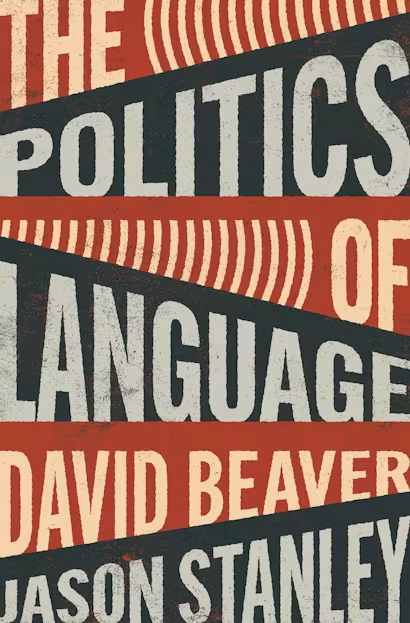
I’m still working on The Politics of Language by Beaver and Stanley.


Posted in Ideas and Opinions, Language, What People Are Reading | Comments Off on What I’m Reading February 2026