
 Follow
Conquering the Canon by Scott Kaiser
You can find my review here. An excellent look at Kaiser’s career, the Oregon Shakespeare Festival, and the craft of theatre.


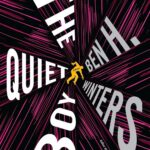
The Quiet Boy by Ben H. Winters
I’ve been a Ben Wibter’s fan since The Last Policeman trilogy. He always manages to weave a story in which there is a deep philosophical questions lurking below the surface of the story: In The Quiet Boy, Wesley Keener (who we never actually hear from) has undergone surgery for a head injury and is transformed to an automaton who paces endlessly. Enter Jay Shenk, a malpractice lawyer who convinces Wesley’s parent to hire him.
There is also a cult which sees Wesley Keener as a doorway to another world without pain or guilt, a world which will come about by killing the boy. As his working-class parents struggle with Wesley’s care and Shenk tries to win his case—with the help of a quirky expert witness, the story shapes up to be a legal thriller. Shenk’s son and Wesley’s sister become involved, Wesley’s parents become estranged, and Jay Shenk hits bottom as the narrative alternated between the accident and its aftermath. Ultimately the book is about relationships and whether we a able to face the arbitrariness of existence.
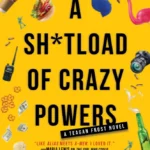
Eye of the Sh*T Storm and A Sh*tload of Crazy Powers by Jackson Ford
I finished the Frost File series so far. In books 3 and 4 of the Frost Files, the psychokinetic young woman Teagan Frost faces another genetically altered child, this one lost in Los Angeles, which is still suffering from the earthquakes of book 2. As a devastating flood is about to hit a camp of homeless people, she has to decide whether to reveal her powers to save them—and incur the rath of her government handlers. And in book four, her powers are out of control as she tries to defend again an apparent terrorist group, which turns out to be connected to her sinister siblings. I’m ready for book 5, which seems to be tied up in some publishers sh*tstorm, so I’m hoping it appear before too long. There is much to be wrapped up, and there are rumors of a streaming series.
Dinner at the Midnight Library by Hika Harada
A library that opens only at night, staffed by former librarians and booksellers and containing the donated books of (fictitious) famous authors. When Otoha Higuchi, an unfulfilled bookstore clerk, takes a job at the mysterious library, she meets intriguing colleagues each with a backstory. And the bookstore patrons are quirky with various mysteries as well. I made the mistake of reading this after a face-paced thriller, so it seemed a bit slow to start, but became more intriguing as I read. Every state should have a night library!
Botvinnik One Hundred Selected Games by Mikhail Botvinnik—I finished reading and playing through Botvinnik’s collection of games from 1926-1946, at a pace of about one day. Botvinnik’s annotations to the games is revealing in their pre-computer depth so readers and you get to follow Botvinnik thought process, preparation, and tournament strategy. A special bonus too is his essay on The Russian and Soviet School of chess. He gives props to Chigorin and Alekhine as leaders of the Russian School but goes full on patriotic new-Soviet-man talking about the Soviet system (Stalin, who took an interest in Botvinnik’s success was still alive). “We highly appreciate the opportunities afforded to us by our State, our government, and the Bolshevik revolution. We recognize our responsibilities, and so never before has chess been played so seriously ….” One prescient note: while praising the Soviet system and the “care and attention” given to promising young players, he says “For instance in Leningrad, the twelve-year-old first category player, Boris Spassky, has proved outstanding.”
