
 Follow
Review of How Deeply Human is Language: Chomsky, The Brain, and the AI Fantasy by Yosef Grodzinsky
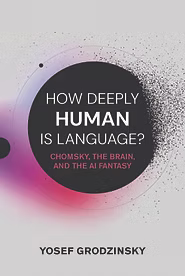
In this short and lucid work, Grodzinsky (Director of the Neurolinguistics Lab at the Edmond and Lily Safra Center for the Brain Sciences) provides a two-fold approach to the question of the nature of human language and whether A.I. models can model that nature. He begins with an overview of Chomskyan linguistics in Chapters 1 and 2. In Chapter 1 Grodzinsky gives a short sketch of theoretical grammar and the early version of Chomsky’s Transformational Generative Grammar. With this background, Chapter 2 moves to later, more abstract theories focused on a minimal set of highly constrained rules, notable the operations MERGE and MOVE. These two chapters are an excellent review and clarification for those familiar with linguistic theory, but may be challenging for the uninitiated.
Chapters 3 and 4 turn to the history of A.I. from early machine learning attempts to later deep learning to Large-Language Models (LLMs). Chapter 3 focuses on the development and early evolution of neural networks from work on simple perception to the techniques of back propagation and deep learning through weighted connections between neurons. Chapter 4 covers the development of statistical models of language generation, notably ones involving Recurrent Neural Networks (RNNs) and Long Short Term Memory (LSTM). Again, these may be challenging to those unfamiliar with the history of such models but are worth the effort.
Chapters 5 and 6 take a critical look at some of successes and failures of LLMs. Grodzinsky offers more than a catalog of Chat-GPT flubs or a screed against A.I. in general. Rather, he demonstrates—convincingly to me— that present-day LLMs cannot model the linguistic knowledge of English speakers (or presumably those of other languages) as well as linguistic models do. In Chapter 5, he tackles the claim that LLMs refute the innateness hypothesis, a claim central to much Chomskyan linguistics, and he argues for the importance of constraints on theories and model (with the clever example of the periodic table of elements). Key to Grodzinsky’s position is that predictive success does not equal a valid scientific theory or description of a phenomenon. In Chapter 6, he describes the Winograd’s Challenge Schema (involving anaphora resolution) and other benchmarks for LLM performance, including especially ambiguity detection.
Chapters 7 and 8 lean into Grodzinsky’s academic specialty, neurolinguistic modelling. Chapter 7 deals with the neuroscience of brain localization (from Broca and Wernicke to present day fMRI studies) and some of the ways that linguistic theories are congruent with anatomical studies. Chapter 8 focuses on studies of LLM performance as they relate to brain anatomy and human linguistic performance. Here Grodzinsky critiques existing studies of LLMs and suggests that much more refined types of studies are needed.
The Epilogue, subtitled “Shall We work together?”, suggests collaborative efforts between linguists and LLM engineers, and points to the success of work on semantic priming. For Grodzinsky, the tension between engineering and theoretical modeling can result in a productive exchange, but we are not there yet.
Overall, How Deeply Human is Language does a superb job of outlining major areas of contrast and confluence between Chomskyan linguistics and A.I. engineering, such as the role of innate components, the types of learning methods involved, the role of constraints on theories, and the transparency of mechanism.
