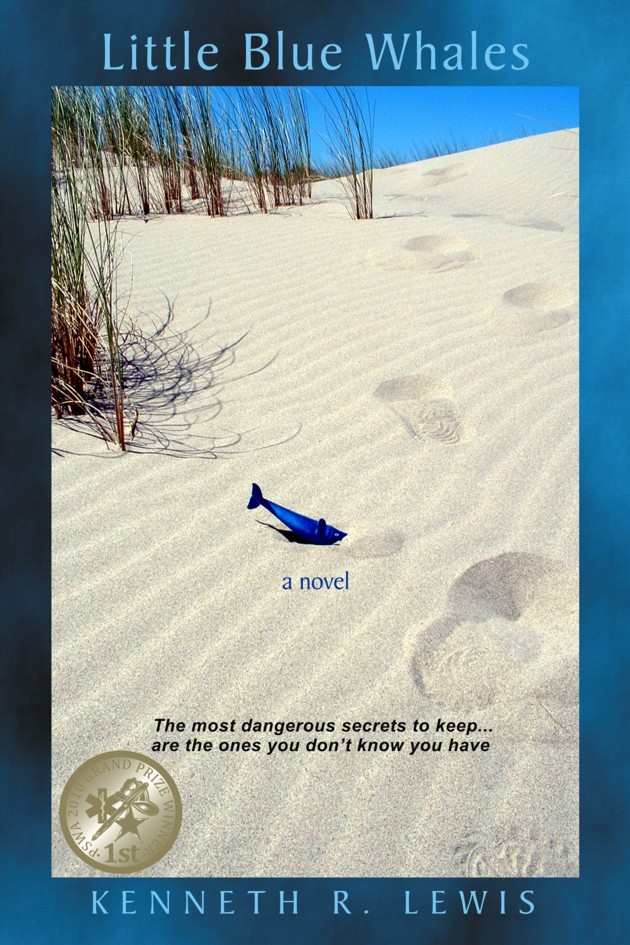
Kenneth R. Lewis is a career law enforcement officer and author. Little Blue Whales, his 2009 crime thriller won the 2010 Public Safety Writers Association First Grand Prize for fiction. And his 2011 sequel The Sparrow’s Blade was awarded an Eric Hoffer Award in the category of Commercial Fiction. Watch for his next novel, The Helical Vane, scheduled for publication in the Fall of 2013. Ken is also the founder of Krill Press, a small independent publisher specializing in mysteries. You can follow Ken and Krill on Facebook.
EB: You’re a police chief and an author. When did you decide you were a writer? Have you always written?
KL: I think it was when I was in 6th Grade and was failing math miserably. I didn’t understand it, didn’t like it, and I didn’t want to understand it or like it because it was BORING. However, there was another class that I loved and that was English—particularly English Composition. For every D I racked up in math class, I could easily counterbalance it with an A in English, especially when the assignment was to write a short story, or a book report. I launched my writing career at Washington Elementary School that sixth grade year with publication (by my teacher, in English class) of my short story “The Forest Ranger” the thrilling tale of a stoic Garry Cooper-like forest ranger who lived in a small mountain town, and who was battling unruly and intoxicated town ruffians trying to run him off while at the same time trying to save the town from a deadly, marauding mountain lion, and also win the heart of the local school marm. I’m pretty sure my work at that time was heavily influenced by both Gunsmoke, and The Andy Griffith Show. However, it still brought my D average in math up to a B-. I sold my first short story, “The Willow Tree,” to a magazine called Farm Wife News for fifty dollars when I was twenty-one.
EB: How did you come to be a publisher?
 KL: It was out of both necessity, and a strong sense of parental responsibility. In 2006 I joined an organization called Willamette Writers for the sole purpose of attending their annual summer conference that year and, hopefully, finding an agent for my first novel, Little Blue Whales. I did find an agent, and over the next two years we came really close to selling Little Blue Whales and at one point, we had a verbal acceptance from St. Martin’s Press, pending a rewrite to get the word count of the book down from its original bloated 178,000 words. Eight months, and seventy-six thousand words less later, we returned to St. Martin’s with a leaner, meaner version of Little Blue Whales which was ten times the book the first version was but the economy had soured and the Big New York Publishers just weren’t buying anything from unknowns. Over lunch at the 2008 Willamette Writers Conference my agent suggested I “forget” about Little Blue Whales and write something else, but I couldn’t do that.
Writing a novel is like creating and giving birth to a child. You wouldn’t leave your two-year old on a curb somewhere with a sign saying “Please take care of my baby. I’ve moved on to something else.” would you? In the middle of buttering my sourdough roll, I calmly informed my agent that if the only thing standing in the way of getting Little Blue Whales published was lack of a publisher, then I would simply learn the publishing business. After all, publishing wasn’t exactly rocket science, was it? This was in August of 2008, and I incorporated Krill Press the following month on September 17, 2008. Our first mystery title, Absinthe of Malice, by Pat Browning, was published on November 13, 2008. The name Krill Press is taken from a scene in Little Blue Whales which talks about how the largest mammal on earth, the blue whale, is totally dependent on one of the smallest creatures in the ocean, a nearly microscopic shrimp called krill, and how these behemoths of the sea would perish from the earth without the krill, which is their mainstay food source. It is obviously a metaphor for why we need small publishers in the literary world, and it is also a great conversation topic at cocktail parties. It makes people believe I am cleverer than I really am. By the way, Little Blue Whales, the novel my agent suggested that I just forget about and move on to something else, was published by Krill Press in 2009, and in 2010 it won the Public Safety Writers Association First Grand Prize for Fiction.
EB: You’ve described Krill Press as a micropublisher? Is that like a microbrewery for books?
 KL: Yes, exactly! We are even smaller than a traditional small press, publishing only five to seven titles a year, and not because we want to, but because this is the maximum workload the press can accept at this time with the resources we have on hand. If I ever gave up my day job, I would imagine we could double, or even triple that number of titles published every year, but I’m not ready to do that quite yet. However, there is no lack of material out there, even with the explosion of self-publishing in these last few years due to the revolution in digital publishing. Anyone can publish a book now, but not everyone can find a publisher, to publish their book, and many authors still hold having a publisher for their work, in very high regard. This is why, on our website, we are always “closed to submissions” because the few times we have changed the message to “open for submissions” we have literally been flooded, overwhelmed, with author queries.
EB: As a publisher what do you look for in a manuscript? In an author?
KL: I like to say that good writing is like pornography…you know it when you see it. Or, in the case or manuscripts, you know it when you read it. After being a publisher for five years now, I have developed my own internal rating system I like to call the Triple A System in which, after reading the first fifty pages of a manuscript (but in reality, usually the first two or three pages), I am able to rate a submission as either Awful, Amateurish, or Awesome. I really don’t get many “Awful” manuscripts. The most predominant category seems to be the “Amateurish” ones, manuscripts from authors who are trying very hard at their writing, and some who eventually may even make it…just not this time around. The “Awesome” manuscripts jump right out at you, and it’s like being hit square between the eyes with a baseball bat!
This summer, Krill Press was invited by Willamette Writers to be on their coveted Agent, Editor, Film List as an acquiring publisher actively seeking new writing talent. Besides being in a way, a very weird experience, sitting in the opposite chair as a publisher at the same tables and in the same I sat as an author six years before, hoping to get a book deal myself, it was also a heartwarming, heart wrenching, and sobering experience! Fourteen authors signed up to pitch their mystery books to Krill Press, and I requested the first fifty pages of every author’s novel who pitched to me, of which, so far, eight authors have. Of the eight submissions, one was awful, four were amateurish, and three were awesome. Of the three awesome novels, one, Dysphoria, by Karelia Stetz-Waters, was contracted for on Friday, September 28, 2012, and will be published in January 2013. The other two submissions are still being considered, and both stand a good chance at this point of going to contract, but Dysphoria was definitely that baseball bat smack between the eyes! It truly is an “awesome” book, as are all of our other Krill Press titles currently in print. As for what I look for in an author? I have very little choice in that selection, because they always seem to come with the book as a package deal! Just kidding. All of the authors I have now, and have had in the past, are terrific people. However, if you are some sort of jackass as an author, or turn out to eventually be one, no matter how awesome your manuscript may be you are ultimately not going to be published or retained by Krill Press.
EB: What been the most important lesson you’ve learned in starting a publishing company?
KL: That publishing really is, in a way, rocket science! I was so naive when I started this business; I had absolutely no idea what I was getting myself into. However, my love of good books, and the fact that I made promises to people, bound myself to them, and their precious books by virtue of legal, written contracts, made me learn how to be a publisher. I don’t like failing, in anything that I do, and I can honestly say that in the five short years that Krill Press has been in existence, we are much more of a success story than we are in any respect a failure. We are starting to build a really good reputation in the writing community, and authors are now seeking us out, specifically, to see if there is a possibility that we may be interested in publishing their book.
EB: Are you still finding time to write or are you spending more time as a publisher?
KL: Honestly? I have been spending more time as a publisher than I have on my own writing. I mean, look how long it took me to get this simple little interview to you, Ed! I also do a yearly blog piece for Kay Barley on her great writer’s site, Meanderings and Musings. These are scheduled a year in advance…a whole year! Mine is set to appear tomorrow, September 30, yet last weekend, at this same time, I was still busting my butt to finish it. I finally did finish it, the next night, and emailed it to Kaye because she needs to get them at least a week in advance. It has been almost two years since The Sparrow’s Blade was published, and I am still in the research phase for my next novel, The Helical Vane, which is set in Idaho and is about baking and archery. I am making my second research trip in two years to Idaho next month, and I have pledged to turn off the Krill Press spigot this winter, after getting our next three books into print, and concentrate solely on finishing at least the first draft of The Helical Vane before next summer.
EB: How have ebooks changed things for publishers?
KL: I’m not entirely sure, definitively, because as a publisher we have always brought out Kindle and NOOK editions of our print books, simultaneously. I can tell you this: for every 1 of our print books sold, we sell approximately 50 eBooks of that same title. My sense of things, though, is that it has probably dramatically and irrevocably changed the traditional publishing model in this country forever. One negative factor, however, has been wannabe authors who are so anxious, so desperate to have anyone read their work, that they started the “free eBook” craze which has ended up hurting everyone—publishers and authors alike. And not just wannabe authors, but some fairly “big name” authors too! All of our eBook editions are priced at $2.99, the current, acceptable price point for Kindle and NOOK downloads. We have experimented in the past with having some of our eBooks on “special” at 0.99 for a short period of time, but never any lower. As far as I am concerned, 0.99 is free! Especially when you consider the print version of that same book sells for $16.99.
EB: You also do great cover designs. What are the elements of a good design?
KL: I love creating book covers. Absolutely love it! I can’t draw for crap, but give me a computer loaded with Corel-Draw, and access to a few online stock photo companies, and I can create a cover design that makes people want to pick that book up off the book store shelf and thumb through it, or hit the “Click To Look Inside!” icon on Amazon.com. That age-old adage about not being able to judge a book by its cover is definitely out the window at Krill Press , because we want you to get a sense about what is inside those covers. We do that by designing strictly high quality, custom covers, which are always tied to some key scene, or meaningful reference in the book…even to the point of having the author slightly rework a scene, or a passage in their manuscript so the cover is a perfect fit.
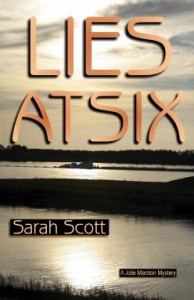 In our most recently published title, Lies at Six, by Sarah Scott, her novel opens with one of her characters sipping a glass of Jack Daniel’s as he looks out his living room window in Memphis at the winter sun setting over the Mississippi River. The novel itself is predominantly about Jolie Marston, a former Memphis TV anchor trying to solve the murder of a friend, and who now finds herself in exile after having a meltdown on live TV. So shouldn’t the front cover be filled with all kinds of frenetic images of the fast-paced life of a popular female TV personality, and all of the glamour and glitz that goes with that kind of lifestyle? Instead—and in keeping with our belief that “less is often more” when it comes to designing incredible book covers—the front cover of Lies at Six is a dark and moody shot of a tugboat silently plying the muddy waters of the Mississippi at dusk, with the title of the book in a large font that is filled with the colors of the sunset. Turn the book over, and on the back cover, you will find ample representation of who Jolie Marston is and what she has got herself into.
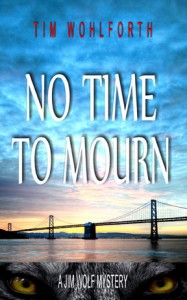 Or take a look at our most recently designed cover for book #2 in Ashland, OR author Tim Wohlforth’s Jim Wolfe private eye noir series, Epitaph For Emily, and compare it to the cover of book #1, No Time To Mourn. Both covers evoke the area of operations Wolfe works in—the San Francisco, Oakland, Berkeley area—and all of them, including the yet to be written book #3, will be tied together by the distinctive “wolf eyes” banner at the bottom of each cover. Cover design is definitely the best part of my job as a publisher, and it also saves the business anywhere from $500.00 to $1,500.00 per book by designing our own covers in-house, not to mention the added value of getting exactly what we want for each individual book. All of our covers can be seen on our website, www.krillpress.com.
EB: How can readers get Krill Press books?
KL: Krill Press print books can be purchased direct from nearly every online bookseller, or ordered through your local bookstore using the book’s ISBN number, and eBook editions are available from Amazon Kindle, Barnes and Noble NOOK, and Google eBooks. For bookstores, other retail outlets, and book clubs, our titles are distributed through Ingram, or you can order directly from us using our own in-house distribution program called Krill Direct, which includes generous wholesale discounts, and an accommodation for returns with certain conditions. Send us an email query to orders@krillpress.com if you are interested.
 Follow