
Yet another thought on ghostwriting…

I find it interesting that we all have such strong feeling about ghostwriting. But even more surprising to me is how most of you are on the opposite side of this goldmine of new opportunities than I am.

Think of the potential for new writers! We don’t have an established name like Stephen King (who wrote under a pen name in an effort to preserve the “king” brand) or J.K. Rowling. We cannot expect that the first book we write is going to be a best-seller or even get published. And can you think of a better or faster way to build strong connections in the publishing world?

Who cares what Kirsten Hersh has to say? But what if I could write a Nancy Drew book, or two or three, until I figure out what I have to say? Or moving to the non-fiction world: what if I could help someone turn their research or opinion into a work that would be readable and interesting, not boring and academic? What is wrong with that?

And in a world where movies and TV shows dominate everyday life, and the most relate-able books in the YA section are ghostwritten, are we going to rail against the quality of ghostwritten books, which can’t be that bad or Nancy Drew and Goosebumps wouldn’t be famous still today, or be glad that young adults are reading? Harry Potter and Twilight aren’t literary gold either, and they aren’t ghostwritten. But they appealed to kids in a way “literary” works can’t. I care more that books don’t die forever, or move permanently to a Kindle/iPad/computer screen, than if the books that draw in new readers are ghostwritten.

Personally, I think this is the first new aspect of publishing I have heard about that gives me hope. I’m not a magazine article writer, fiction writer, or publisher. But ghostwriting nonfiction? That sounds fascinating. I love writing research papers, and hate writing poems. I have taken twice as long as necessary to write my capstone because there is so much interesting information to include that I can’t decide what not to include. But a 100-page capstone won’t do either. And now I’ve been told I could make a career out of this? I love it. I think it’s genius. Just because someone has ideas doesn’t make them a writer. And just because I can write, doesn’t mean I want to spill my guts on the page. I would rather help the non-writer make her ideas a publish-able possibility.
Posted in Ideas and Opinions | Comments Off on Yet another thought on ghostwriting…

Ashland salutes Lawson Inada

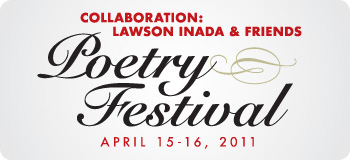
On April 15, 2011, nearly 200 people gathered in Southern Oregon University’s Schneider Museum of Art to recognize Lawson Inada, who served as Oregon’s poet laureate from 2007 to 2010. The program opened with a short tribute from Tacoma poet Rick Barot called “Bringing Words Together: Lawson Inada’s Contribution to Literature” followed by a collaboration between Lawson and musicians Terry Longshore and Todd Barton.

Lawson Inada and Friends

Collaboration was the theme of the daylong workshop on April 16. As Lawson pointed out in the roundtable discussion at the end, collaboration was once frowned upon. If you were a collaborator, you were not thinking for yourself. Today, collaboration is more appreciated as a way of creating openness and energy and new ideas across media, languages, genres and borders. SOU professors Miles Inada and Robert Arellano, collaborators in a new Center for Emerging Media and Digital Art, talked about their collaboration process and showed their digital poem called “The Soul’s Mailbox.” I’ve been wondering for a long time whether animation will become this generation’s poetry, with metaphor and meter replaced by scene, sequence and frames per second. Maybe.

Rick Barot read from his own work including the wonderful poems “The Poem is a Letter Opener.” The mailbox and letter opener reminded me that the imagery of sending letters remains well entrenched even if the actual practice seems to be on its way out.

Portland poet Kirstan Rian read from her book “Chords: Poems as Part of the Whole” and talked about her work in Sierra Leone collaborating artistically with the victims of that war-torn country. And in the afternoon, Paul Merchant, of Lewis and Clark College, read from and discussed his translations of the poetry of Yannis Ritsos and his own historical poems.

There was a lot to absorb and reflect on—the role of craft and whether poetry can be taught came up leading to the question of whether collaboration can be taught. The speakers debated the cheapness or regency of content–is content king or just filler? And they described how content is translated and reinterpreted and how those processes allow us to reinterpret ourselves and others.

I picked up some new expressions too—from Rick Barot, who described the “amniotic slick” of a new piece of writing and the “Whitmanic” style of a particular poem, and from Miles Inada, who pointed out the need to “future-proof” art. As for Lawson Inada, his work is already future-proofed.

Posted in Literary Events in Southern Oregon | Comments Off on Ashland salutes Lawson Inada

World Intellectual Property Day

Monday was World Intellectual Property Day 2011.

In honor of that here is a brief description of copyright, courtesy of the US Copyright Office, a division of the Library of Congress.

Copyright … protects original works of authorship including literary, dramatic, musical, and artistic works, such as poetry, novels, movies, songs, computer software, and architecture. Copyright does not protect facts, ideas, systems, or methods of operation, although it may protect the way these things are expressed.

The Copyright Office FAQ answers two key questions: “Your work is under copyright protection the moment it is created and fixed in a tangible form that it is perceptible either directly or with the aid of a machine or device.” [So essentially, you need to write it down or type it up.]

Do you have to register a copyright to be protected? The Copyright Office says “No. In general, registration is voluntary. Copyright exists from the moment the work is created. You will have to register, however, if you wish to bring a lawsuit for infringement of a U.S. work.” [So, the answer is no, but …]

What’s the difference between copyright and trademark? Trademark is the domain of the US Patent Office which describes it this way:

A trademark is a word, name, symbol, or device that is used in trade with goods to indicate the source of the goods and to distinguish them from the goods of others. A servicemark is the same as a trademark except that it identifies and distinguishes the source of a service rather than a product. The terms “trademark and “mark are commonly used to refer to both trademarks and servicemarks.

Trademark rights prevent others from using similar marks that confuse consumers, but it doesn’t prevent others from competing under a different trademark.

Posted in Ideas and Opinions | Comments Off on World Intellectual Property Day

Yet another post on ghostwriting…

For some reason, as a small child I learned about ghostwriters (from where?  No clue), and instinctively learned to keep away from ghostwritten series.  I could spot one from a mile away.  Other than The Boxcar Children, and a few “horsie” stories here and there, I never read ghostwritten books because even as a kid, I could tell the quality wasn’t there.  I didn’t want to waste my time on something the writer didn’t care about, heart and soul.  So I spent my days reading Avi or Eoin Colfer instead.  And okay, The Boxcar Children too, but I definitely liked the ones written by the original author the best.

To me, something’s missing when a ghostwriter creates something, excluding perhaps autobiographies (I’ve never really read any so I don’t know).  Writing something in six weeks isn’t crafting something.  I won’t deny that it’s skillful, and probably a very interesting job, but it feels…cheap.  Churning out these books with little substance to unknowing children.  I mean, the Babysitter’s Club?  Sweet Valley High?  Barf-worthy.  They are fluff.  There are hundreds of children’s books out there written by the original author that are easy to read but contain…that higher something.

In an effort to explain what I mean by that, when I write fiction, though I rarely do, I’m invested in what I’m writing.  I love the words and the ideas, and I really care about the entire process.  It also takes me ages to write anything.  I could not see myself writing over a hundred pages in a month–I can barely write ten in that time.  But then again, those ten are good, on an amateur writer’s level, that is.  They have passion, and care, and soul.  Ghostwritten books lack that.  The idea is not the writer’s own.  He or she may be interested in the story, or interested in the audience that story will be read by, but I doubt many ghostwriters actually care that much.

When I was a kid, I hungered for quality.  I’m sure most people in our class grew up with the Harry Potter books.  Do you remember how excruciatingly wonderful it was waiting for each one to come out?  I wouldn’t have been that excited about The Babysitter’s Club releasing a new book.  Part of being a kid is that wonderful waiting feeling–the entire week leading up to Christmas, the last few days of school before summer starts, etc.

This is not to say that I’m demeaning a ghostwriter’s job.  I understand entirely taking the job.  I wouldn’t necessarily be opposed to it myself, although I think I’d find it wasn’t a good fit for me.  I’m more opposed to the business of it all.  Sure, making tons of money is awesome, but at the expense of children?  Come on.  Quality over quantity, always.

Posted in Ideas and Opinions | 3 Comments