Interview with Mary Jane Cedar Face, Collection Development/Social Sciences librarian and editor of BookMarks.
Tell me a little about yourself? (What’s your education background? How did you become the Collection Development/Social Services librarian? Have you or do you work on other publications beside BookMarks?)
I went to Douglass College in New Jersey, which is the all-women’s part of Rutgers University. I graduated in 1977. I always wanted to be a librarian, and while I was a senior we were allowed to take one class at the graduate school of library science; so I did and I loved it. Then other things got in the way, although I did work in libraries. I was a coordinator of Special Collections at Southern Utah University in Cedar City Utah before becoming a librarian.
In 1986, I went back to get my Masters in Library and Information Science at Rutgers University. While I was there I also got a Masters in Anthropology, and completed coursework for a PhD. Unfortunately, I never finished my dissertation. While in graduate school I had an assistantship at the computer center, maintaining a small departmental library and managing the machine readable data files, which are large files of quantitative data used in research.
In 1993, I came to SOU as a cataloging librarian. I became the collection development librarian a few years later, which I really love. And I have always loved Special Collections; oversight of Special Collections/University Archives is also part of my current job.
I haven’t worked on any other publications. Librarians are faculty and we’re expected to write articles or book reviews. I usually do 4 to 6 invited book reviews each year that are published. I haven’t written regularly as a journalist.
How did you first become involved with BookMarks? (And, how did you become editor?)
I suppose I ended up being asked to work on the newsletter because…I can write. I like to write.
Someone else had been the editor of the old newsletter, Connections and it was on hiatus for a year or two. We decided to bring the newsletter back, with a new name, BookMarks, with a new look and feel, and with me as the new editor. It’s been about ten years since I first began working on BookMarks.
The old newsletter was created in-house, in black and white. We felt that it was worth investing in the newsletter since it is the public face of the library. We began working with the University Publications office. Greg Martin, their graphic designer, developed the masthead and layout that is used to this day. I think BookMarks has a classier look and feel. I would write the content, the copy, and University Publications did the formatting, graphic design, and final editing. With retrenchment came budget cuts. A few years ago we went back to doing the graphic design for the newsletter in-house again.
Who is the primary audience for BookMarks?
BookMarks is intended for an external as well as campus audience. A primary audience is the membership of the Friends of Hannon Library. We also write news that may be of interest to faculty, staff, administrators, students, and potential donors.
What are your main tasks as writer and editor?
I always try to keep in mind that I may hear about something that’s newsworthy, and need to remember this for when it’s time to write. I need to know what’s going on in the library. When it’s time to write the newsletter, I might go back to someone and ask, “So didn’t I hear your area started this new service? Can you tell me about it?” I try to keep track of what’s going on in the library, so that I can later get information to announce in the newsletter.
Eventually I write short articles about library news and the regular columns. Basically, by doing this, the newsletter builds itself.
What has been a challenging aspect about producing BookMarks?
Now that we are doing the graphic design in-house, we needed someone in the library to become proficient in graphic design and the InDesign software program. Brent Cummings took this on and has done a great job. There was a big learning curve. Now we’ve got a routine. As in the past when we outsourced to Publications, I email him the content and an idea about where it should go. He tries to make things fit. Then we go back and forth a few times, until we okay the final version.
What do you find to be the most enjoyable aspect about producing BookMarks?
It’s always fun to see BookMarks finished. I also like promoting the library, so that’s fun. It’s satisfying.
How do you decide what content goes into BookMarks?
Our top priority is library news, especially new services. For example, when we began bicycle check-out in the library, this was a priority news item and we made room for the announcement. We have a few regular columns. We always have the library dean’s column, “The First Word.” We always have “The Friends Corner” for news about the Friends of Hannon Library, who help us in so many ways. The center article on the inside is typically our “feature” article. If there is something we want to focus on, it is placed in this central position and other news surrounds it. We also highlight upcoming library events in each issue.
In the past, if we occasionally didn’t have enough news, we might have an article about issues in academic libraries. We really don’t have that problem anymore. We always have things we need to announce, from new electronic resources to new services. We’re also trying to include more images for visual appeal, which take up space. Our problem more frequently is that we have too much to say and we have to cut something. What we cut is usually the least time-sensitive article that can wait until the next issue.
About how many hours does it take to create BookMarks from beginning to publication?
For my part, I would say 10 to 15 hours per issue. It’s not that much. I often will write an article a day or a few at once while I am at the reference desk. I like the variety in my job; if I’m tired of doing a task, I’ll stop and write an article. If I have to write several articles at once, I may break them up with another activity. It doesn’t seem that difficult. I also spend time communicating with Brent, our graphic designer, and time proofreading. I work with people in library administration to order address labels, arrange printing and mailing, and so on. We’re down to two issues a year because of the budget. I would guess that there is total of 20-30 library hours put into each issue by various folks.
Is BookMarks primarily a print newsletter, an online newsletter, or both? If BookMarks is printed how/where is it printed, what is the range of distribution (Ashland or all of Jackson County), and how many are sent out? If BookMarks is online do you have an email mailing list that lets people know when a new issue of BookMarks has been published?
Initially BookMarks was only a print newsletter. We printed 1500 to 2000 copies, with an all-campus faculty and staff distribution and a large off-campus mailing. We mailed it to the Friends of Hannon Library and to other libraries in Oregon and Washington, and so on, and placed copies around the library.
After the budget cuts of retrenchment we discontinued the faculty and staff print distribution; we now send faculty and staff an email with an attachment of the pdf of the issue. BookMarks now is primarily online; we print only about 500 copies. We reduced our mailings to only Friends of Hannon Library members and a short list of others. This still allows enough for us to put some copies in brochure racks on each floor for students. BookMarks is available on our website.
Has the amount of and type of content changed over the years?
Actually, it hasn’t. Content has been pretty constant for the last ten years. The new library dean requested that we add more images, so we have. I’ve heard comments like maybe we should make the newsletter punchier. In the end, we had a formula that worked and we’ve gotten good feedback for the more classic, classy look. So we haven’t changed much over time. BookMarks probably isn’t as appealing to students as it could be. The library utilizes other ways of reaching students, such as MySOU and social networking, and does not look at BookMarks as that venue.
If you could change one thing about BookMarks, what would that change be?
BookMarks is getting a little dated. The look and feel was developed in 1999. We should probably think about updating the look and feel sometime. The Friends of Hannon Library, and others, seem to like it the way it is. That doesn’t mean it has to stay the same way forever.
Are students and/or professors able to write/contribute to the newsletter if they desired?
We would love to have student input. We haven’t really thought of a way to ask for this. There are times when we’ve asked students to write something for us, like when some of our student employees have interesting stories or a student intern authors a guest column. There isn’t that much room for articles unfortunately because there is so much news to put in.
 Follow
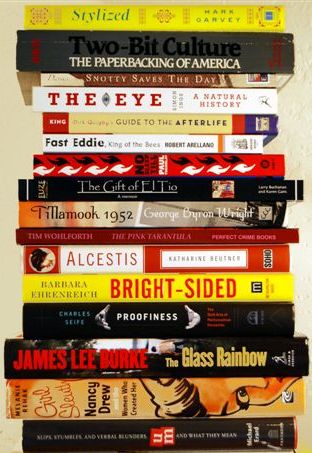 Fast Eddie, King of the Bees by Robert Arellano. His first novel, set in dystopic future Boston.