 Kelley Lusk is a McNair Scholar majoring in English with a minor in vocal music at SOU. Kelley anticipates graduating magna cum laude in June 2019 with plans to teach English as a foreign language abroad.
Women in Writing and the Literary Arts Gap
The experiences of women, historically, have always been shaped by their gender along with the intersections of their class and race. By the 19th century, the concept of reform for white women became a salient topic in everyday urban life and journalism. Due to the shifts in views during this time, women began to take on larger roles in society outside the sphere of the home and project their voices through their writing. Throughout the progression of women’s writing from the 19th century to the present-day 21st century, women writers have always been subject to unethical and oppressive male critiques and a disproportionate lack of representation compared to their male counterparts. Since the 19th century, women writers have gained more respect and recognition, however, they are still subject to male criticism and gender inequality within the industry.
When considering women’s rights movements, it’s important to review the first female social reform that took place near the end of the 19th century. According to Sally Ledger, in “The New Women: Fiction and Feminism at the Fin De Siecle” the concept of the New Woman is a term that emerged during the turn of the century, and refers to an independent woman seeking radical change and pushing the limits set by the male-dominated society. More specifically, a woman with multiple identities, “She was variously, a feminist activist, a social reformer, a popular novelist, a suffragette playwright, a woman poet; she was often a discursive response to the activities of the late nineteenth-century women’s movement” (Ledger 1). The New Woman writers used their voices to incite changes in the unjust position of white women in society. Even though this first wave of feminist activism began as an abolitionist movement driven by the black women’s collective feminist consciousness – the New Women writers agenda excluded black women. The movement concluded with the suffragists’ successful passing of the Nineteenth Amendment; this amendment won white women the right to vote.
An example of a 19th century New Woman, is Fanny Fern, an American novelist and columnist who confronted issues of women’s rights and male domination by using humor. Fanny Fern was the pseudonym for Sara Willis, but also the name that she began to go by in everyday life. In her work Critics and Male Criticism on Ladies Books, she satirically criticises male authors and their the unjust and damaging criticism towards women authors (Lauter 2468). Eventually, gaining the respect of the male critic, Nathaniel Hawthorne, who in 1830 stated in his work Mrs. Hutchinson, “The hastiest glance may show, how much of the texture and body of the cisatlantic literature is the work of those slender fingers, from which only a light and fanciful embroidery has heretofore been required, ” hence arguing that for women writers, there had been no change in their status and writing since the 17th century (Howell 23). While Fanny Fern was one of the most powerful female writers of the time addressing gender inequality issues, it was largely only accessible for the white middle class woman.
In 1861, Harriet Jacobs published Incidents of the Life of a Slave Girl, under the pseudonym of Linda Brent. This work addresses her experiences of sexual exploitation, mistreatment from slave owners, family relations, and her journey to freedom for herself and her children. The pseudonym was used in order to appeal to the white audience, and to hide her identity. Keeping her identity hidden was necessary due to the fact that she was subject not only to male criticism, but criticism from the entire white population. As Howell explains, “For most women writers at the time, the mere act of ‘picking up a pen’ held a great significance, but Jacobs challenged what was feared in order to reveal the corruption…” (24). For all women writers during this time, including Fanny Fern and Harriet Jacobs, the use of a pseudonym was common practice, but while they used feminine pen names for different reasons, other women authors felt obligated to use masculine pseudonyms in order to gain recognition. For instance, Louisa May Alcott’s Little Woman, was published under the ambiguous pen name A. M. Barnard in order to be taken seriously. Mary Ann Evans published her work Silly Novels by Lady Novelists, under the pseudonym George Eliot in order to distance herself from her critiques that call out fellow women writers for their formulaic romance novels.
By the 20th century, Karen Oosterhous a publisher at Firebrand Books explained the real reason that keeps women from expanding outside those expected genres, such as romance, “…the old cliche goes that women write romance novels and books about cooking and men write spy thrillers, and if women want to succeed at least financially, they often are forced to stick to that field” (Foster 30). The lack of representation of women in any other field except romance and cooking made it difficult for women to break out of of those genres. Oosterhous also explained that reviewers only want to review books that they believe are of interest to their readers. This is problematic because not only are a majority of reviewers male, which automatically creates a bias, but reviewers also tend to “shy away from books that may be controversial or that relate to only a segment of the population. I think that books like that, books about feminist or the gay experience, have something for everyone, but many reviewers don’t think so” (Foster 54). These magalized stories, such as the gay experience or stories of different cultures and people of color, haven’t been taking seriously by the majority audience, which only leads to further marginalization. This, in part, could be helped by the reviewers expanding beyond the norm. Reviews are very essential for books and authors, especially ones being published by smaller presses (Foster 33). Today, the amount of competition out there is intense, and simply having a quote from a major reviewer, like the New York Times, can set a book apart from all the others.
However, it is also important to acknowledge that during the 20th century some of the greatest advancements in the feminist movement were made because of women authors like, Simone de Beauvoir, Sylvia Plath, Maya Angelou, Audre Lorde and Virginia Woolf, just to name a few. In “Publishing the Patriarchy: Reviewers in the White, Western Tradition Still Exclude and Trivialize Women Writers,” Chloe Foster explains that “In 1929, Virginia Woolf, the emblematic face of the female literary triumph, set out to unearth the reasons why her generation and the women before her, did not practice the craft of writing” (Foster 30). What she along with many other feminist have concluded is that “…women were prohibited from entering traditional male institutions and were regulated to childbearing and rearing, and because of this, women could not penetrate the elite world of the male literary property” (30). Because women were only represented as, and taught to be, domestic, they weren’t allowed any room to believe they could be capable of more. Further, not having anyone like yourself represented in a field that you are interested in, leads one to believe that someone like yourself is not fit for that position.
By the end of the 20th century, 1998, the groundbreaking article, “Scent of a Woman’s Ink: Are Women Writers Really Inferior?” by Francine Prose, exposed the gender disparities in journalism and explained the harm that male critics have had on women writers. For instance, Norman Mailer in 1959, on his “expansive confession of gynobibliophia: ‘…I can only say that the sniffs I get from the ink of the women are always fey, old-hay, Quaintsy Goysy, tiny, too dykily psychotic, crippled, creepish, fashionable, fridged, outer-Baroque, Maquille in mannequin’s whimsy, or else bright and stillborn’”(62). This attempt, and attempts like Norman Mailer’s, sought to place women outside the literary field altogether. It is still not a wonder why writers like George Eliot, George Sand and the Brontes felt the need to hide behind their male pseudonyms. Edith Wharton, a Pulitzer Prize winning American novelist, who in 1930 was subject to criticism by the male critic, Ludwig Lewisohn who stated, “‘wars and revolutions, cataclysm and catastrophes of man and nature leave her hopelessly a lady’” (Foster 32). Regardless of Lewisohn’s criticism of her “triviality”, Wharton remains one of the great 20th century American writers. Prose explains that women writers used the domestic scene to symbolize larger issues, and that male reviews simply could not get past the literal interpretations (Prose 63). In the early 1970’s the feminist authors, “Susan Brownmiller and Nora Ephron held the first organized protest against the representation of women authors in the New York Times Book Review. The two made an appeal to editor Max Frenkel, but nothing came of it” (Gender Disparity and Book Reviews 1). Prose revealed that by 1997, the disparity and representation for women still was a problem in the New York Review of Books. That year they were recorded printing only ten books of fiction by women, and twenty five books of fiction by men (Prose 62).
By the beginning of the 21st century, 30 years after the first protest organized by Brownmiller and Euphon took place, more results of the New York Times Book Review were exposed by Paula J. Caplan and Mary Ann Palko; between 2002-2003, they found that “out of 807 books reviewed, only 227, or 28%, were authored by women. Of the 775 reviews only 265, or 35%, were by women reviewers” (16). Following these results, in 2009 the VIDA: Women in Literary Arts was launched in the UK and in 2010 was launched in the United States. VIDA is a literary research organization whose mission is to “increase critical attention to contemporary women’s writing as well as further transparency around gender inequality issues in contemporary literary culture” (Gender Disparity and Book Reviews 1). Since their initiative, in 2010 proved men take up most the space in literature, gender parity has become more and more possible with each passing year. In the most recent VIDA count in 2017, Amy King and Sarah Clark, the board of directors, found that of the 15 main publications in the VIDA count, only 2 publishers published 50% or more women writers than their male counterparts. Five others represented between 40-49.9% and the undeniable majority, 8 of the 15 failed to publish even 40% by women writers (King and Clark 1).
In 2015 the radical/liberal feminist “‘…Carol Anne Douglas, suggested that women’s books do not receive much attention because they focus on ‘soft subjects’ that men are not interested in’” (Gender Disparity and Book Reviews 1). This essentialist remark had many people questioning what is considered a “soft sobject?” Romance, nostalgia, sex, motherhood? To trivialize these topics as “soft” simply indicates that they are not understood. Women today are grappling with being put into a separate category all together with the arising “women’s literature” or “women’s fiction” genre. This issue comes up throughout many industries, for instance in athletics, women are often referred to as “women athletes” before simply an “athlete.” “The Second Shelf: On the Rules of Literary Fiction for Men and Women” in the New York Times, Meg Wolitzer addresses the instability and the controversiality of the “women’s fiction” genre and the rise of the “American Women Novelist” category. While searching online in Amazon, Wolitzer first came across the “Women’s Fiction” category that listed authors like Jane Austen, Toni Morrison and Louisa May Alcott, and notes that the occasional man like, Tom Perrotta who was listed, solely because he writes about relationships (Woltzer). Woltzer further explains that “…lumping together of disparate writers by gender or perceived female subject matter separates the women from the men. And it subtly keeps female writers from finding a coed audience, not to mention from entering the larger, more influential playing field” (Woltzer). Labeling topics like, relationships, as “women’s fiction” furthers a binary and insinuates that relationships or other related topics perceived as feminine, should have nothing to do with men. When considering the category “American Novelist” which only lists male authors, there is a subcategory labeled “American Women Novelist,” this subcategory was created by librarians. It is librarians job to categories in order make searching as easy as possible. However, moving women to a subcategory only isolates women novelist from the larger category and “others” women novelists altogether (Woltzer), as well as disregards any other gender from the larger category. Woltzer explains the “The Second Shelf” as the process of women authors being categorized as second best, while “The Third Shelf” affects people who are marginalized even more, such as women of color and people who identify as non-binary (Woltzer).
The development of the modern novel used to be largely viewed as a male occupation. Today, we see many more women addressing topics on nationalism, politics, war, and immigration than ever before. The author Chimamanda Ngozi Adichie for instance has become an intersectional feminist icon who in The Thing Around Your Neck (2009), writes about the relationships between men and women, parents and children, in Africa and the United States. In the current political climate “amid the #MeToo era, we must ask if abuse and bigotry are anything but the norm in the world of American arts and letters” (King and Clark 1). The 19th, 20th and 21st centuries have had similar concerns regarding male criticism and gender inequality within the publishing and reviewing industry, and while these concerns are being taken more seriously and gender parity is becoming more possible. The rise of media has created different issues of concern for the present-day women writers. These present-day issues have arised due to deep history of popular beliefs about women, who historically, were forced into those categories to begin with. In order to move forward we need to, like Foster states, “Rather than trying to prove that women are equal, we should just assume it” (34).
Works cited
Caplan, Paula J., and Mary Ann Palko. “The ‘Times Is Not A-Changin'”: Your Impression of the ‘New York Times’ and Other Prestigious Book Review Publications (Present Company Excluded) Is Correct: The Women Are Missing.” The Women’s Review of Books, vol. 22, no. 2, 2004, pp. 16–17.
Foster, Chloe. “Publishing the Patriarchy: Reviewers in the White, Western Tradition Still Exclude and Trivialize Women Writers.” Off Our Backs, vol. 37, no. 1, 2007, pp. 30–34.
“Gender Disparity and Book Reviews: the VIDA Count” Jstor Daily, 2015, https://daily.jstor.org/gender-disparity-book-reviews-vida-count/
Howell, Samantha. “The Evolution of Female Writers: An Exploration of Their Concerns from the 19th Century to Today” University of Hawai’i at Hilo, Vol. 13, 2015, pp. 23-26.
Lauter, Paul. “Fanny Fern, Immanuel Hawthorne.” Heath Anthology of American Literature: Volume a and Volume b, 7th ed. vol. B, no. l, 2013.
King, Amy and Clark, Sarah. “The 2017 VIDA Count” VIDA Women in Literary Arts, 2018.
Leger, Sally. The New Women: Fiction and Feminism at the fin de siecle. Manchester University Press, 1997.
Taylor, Ula. “The Historical Evolution of Black Feminist Theory and Praxis.” Journal of Black Studies, vol. 29, no. 2, 1998, pp. 234–253.
Woltzer, Meg. “The Second Shelf: On the Rule of Literary Fiction for Men and Women.” The New York Times Sunday Book Review, New York, 2012.

 Follow
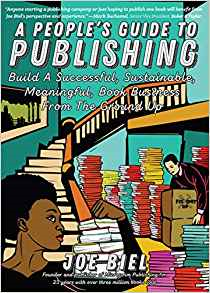 Joe Biel is a self-made autistic publisher and filmmaker who draws origins, inspiration, and methods from punk rock. He is the founder/manager of Microcosm Publishing and co-founder of the Portland Zine Symposium. He has been featured in Time Magazine, Publisher’s Weekly, Art of Autism, Utne Reader, Oregonian, Broken Pencil, Punk Planet, Bulletproof Radio, Spectator (Japan), G33K (Korea), and Maximum Rocknroll. He is the author of A People’s Guide to Publishing: Building a Successful, Sustainable, Meaningful Book Business, Good Trouble: Building a Successful Life & Business on the Spectrum, Manspressions: Decoding Men’s Behavior, Make a Zine, The CIA Makes Science Fiction Unexciting, Proud to be Retarded, Bicycle Culture Rising, and more.
  JB: Around the same time that I met Sidnee, I had just read Publishing for Profit, which is truly an excellent book. Unfortunately, if I hadn’t been publishing for 20 years, there is no way that I could have made sense of what the author is saying in it. It’s very complicated. I wanted to make publishing sound as simple as possible. Publishing is very contextual and there are many moving parts but very little changes quickly and I feel like there is still great opportunity—more than ever—for new small presses to thrive and carve out their own microcosms. And I think you’re astute to notice that mission and vision is why small presses and midlists are growing and thriving now while the market share of the majors is shrinking. There is a strange aversion to having politics in publishing as the rest of the world is increasingly politicized. I think this is a tremendous misstep.
 JB: This is about the cheeriest news that I found in all of my research: the future of publishing belongs to the small press. If you pick a niche that isn’t occupied following my formulas, there is tremendous room to grow and own that platform. From all of the data it appears that the role of major houses will increasingly become solely about buying rights for books that are already successful and outside of the bounds of a midlist or small press. Increasingly, the role of the small press is to take chances, do interesting things, create trends, and change the world.
 CW: So many cookbooks! I’m a collector, and I was lucky enough to inherit my mother-in-law’s pristine collection of advertising cookbooks. She didn’t keep them as a collection per se, but as a Depression-era housewife hung on and used those cookbooks throughout her life. I’m even luckier in that she kept them in meticulous condition. These are, with a few exceptions, printed on flimsy paper with cheap inks and processing. They were intended to be used and not really kept for over 70 years.

 EB: Can you tell us about the title? The book seems to resonate with booms, literal and metaphoric.